LTPS LCD vs IPS LCD: Complete Guide Before Buying a Phone
Published: 23 Aug 2026
You may have seen some smartphones listed with an LTPS LCD, while others mention an IPS LCD. This can make LTPS and IPS seem like two different types of display technology, but they actually describe different parts of an LCD.
LTPS (Low-Temperature Polycrystalline Silicon) mainly refers to the TFT backplane that controls the pixels, while IPS (In-Plane Switching) describes how the liquid crystals are arranged in the display. Because they serve different purposes, both technologies can be used together in the same screen.
That is why LTPS LCD vs IPS LCD is not quite the same comparison as LCD vs AMOLED. Understanding what each technology does will help you better understand smartphone display specifications and evaluate the overall quality of a screen.
What Is an LTPS LCD?
LTPS stands for Low-Temperature Polycrystalline Silicon. In an LCD, tiny thin-film transistors (TFTs) control the individual pixels that form the image. LTPS is a semiconductor technology used to create the TFT backplane of the display.
Compared with traditional amorphous silicon (a-Si), LTPS offers higher electron mobility, allowing manufacturers to build smaller and more efficient transistors. This makes LTPS particularly useful for compact displays that require high pixel density and precise pixel control.
LTPS can help support:
- high pixel density,
- faster pixel control,
- improved backplane efficiency,
- thinner display designs,
- and potentially slimmer bezels.
Japan Display has demonstrated the capabilities of LTPS with a 3.25-inch LTPS TFT-LCD featuring a resolution of 2160 × RGB × 2432, a pixel density of 1001 PPI, and a 120 Hz refresh rate. This does not mean every LTPS display will offer similar specifications, but it shows how LTPS can support compact, high-resolution, and high-refresh-rate displays.
What Is an IPS LCD?
IPS stands for In-Plane Switching. It is a type of LCD technology that controls how liquid crystals change their orientation within the panel to produce an image.
One of the main advantages of IPS technology is its wide viewing angles. Compared with older LCD technologies, IPS panels generally maintain better color and brightness consistency when viewed from different angles.
IPS displays are also known for:
- wide viewing angles,
- good color consistency,
- clear and detailed images,
- and stable picture quality.
These qualities make IPS LCDs popular in smartphones, tablets, laptops, monitors, and other devices where the screen may be viewed from different positions.
Importantly, IPS does not define the type of TFT backplane used in the display. An IPS LCD can use different backplane technologies, including LTPS. This is why an LCD can be both LTPS and IPS at the same time.
LTPS LCD vs IPS LCD: Key Differences
LTPS and IPS are not direct alternatives because they describe different parts of an LCD display. The table below gives you a quick comparison before we look at each difference in detail.
| Feature | LTPS LCD | IPS LCD |
|---|---|---|
| Full form | Low-Temperature Polycrystalline Silicon | In-Plane Switching |
| What it describes | TFT backplane | Liquid crystal technology |
| Main role | Controls pixels efficiently | Improves viewing angles and image consistency |
| Pixel density | Well suited for high pixel density | Depends on the backplane and panel design |
| Viewing angles | Depends on the LCD technology used | Generally wide |
| Refresh rate | Can support high refresh rates | Depends on the complete panel design |
| Power efficiency | Can improve backplane efficiency | Depends on brightness, backlight, refresh rate, and backplane |
| Can they work together? | Yes | Yes |
Now, let’s discuss each point in detail.
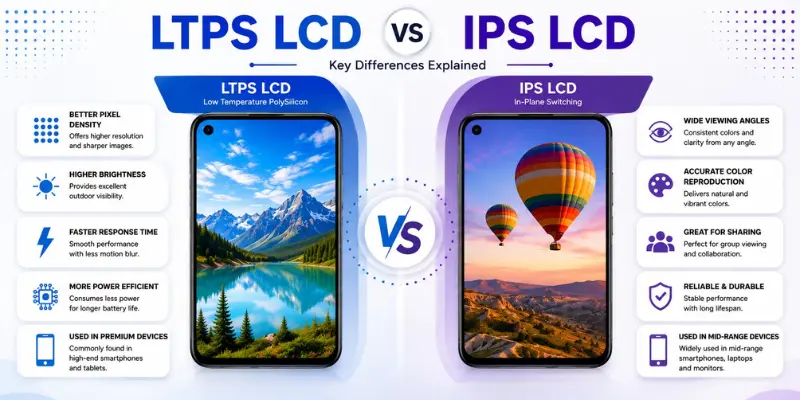
1. They Describe Different Parts of the Display
This is the biggest difference between LTPS and IPS.
LTPS refers mainly to the TFT backplane behind the pixels. The backplane contains the transistors responsible for controlling individual pixels.
IPS, on the other hand, describes the liquid crystal technology in the LCD panel, helping maintain consistent image quality from different viewing angles.
In simple terms:
- LTPS helps control the pixels.
- IPS helps maintain good viewing performance.
Because they describe different parts of the display, an LCD can use LTPS and IPS together.

2. Resolution and Pixel Density
LTPS is well suited to displays that require high pixel density. Its higher electron mobility allows manufacturers to create smaller TFTs and pack more pixels into compact display areas.
However, using LTPS does not automatically mean a screen will have a higher resolution. The final resolution and PPI depend on the complete panel design.
IPS also does not determine resolution by itself. An IPS LCD can have a low, medium, or high pixel density depending on its size, resolution, and backplane technology.
So, if you are comparing two smartphones, check the resolution and PPI rather than choosing a display simply because it is labeled LTPS or IPS.
3. Viewing Angles
This is one area where IPS has a clear advantage in terms of what the technology is designed to provide.
IPS LCDs are known for maintaining better color and brightness consistency when viewed from different angles. This makes them useful when watching videos, sharing a screen, or using a phone from an off-center position.
LTPS itself does not determine viewing angles. If an LTPS LCD also uses IPS technology, it can provide the wide viewing angles associated with IPS.
4. Color Quality
IPS displays are often known for good color consistency. However, that does not mean every IPS LCD will have better colors than every LTPS LCD.
Actual color quality depends on several factors, including:
- panel quality,
- backlight,
- color filters,
- manufacturer calibration,
- brightness,
- and software settings.
So, when comparing smartphones, real display performance matters more than the technology label alone.
5. Refresh Rate and Response Time
LTPS can support high refresh rates and fast pixel response. LTPS LCD panels have been developed with refresh rates of up to 120Hz, but using LTPS does not automatically mean a display will have a high refresh rate.
IPS LCDs can also support 90Hz, 120Hz, or higher refresh rates, depending on the panel design.
For gaming and smooth scrolling, focus more on the refresh rate, response time, and touch sampling rate than simply whether the display uses LTPS or IPS.
6. Power Consumption
LTPS can help improve power efficiency because its transistors can control pixels efficiently. However, overall screen power consumption depends on several other factors.
For example, a display running at high brightness and 120Hz may use more power than another display running at lower brightness and 60Hz.
Battery usage can also depend on:
- brightness,
- screen size,
- resolution,
- refresh rate,
- backlight efficiency,
- and software optimization.
So, it is more accurate to say that LTPS can contribute to display efficiency rather than claiming that every LTPS phone will have better battery life.
7. Bezels and Display Design
LTPS can support compact, high-resolution displays because its transistor technology allows smaller pixel circuits and efficient pixel control.
IPS does not directly determine bezel size. It describes the liquid crystal technology and mainly affects viewing angles and image consistency.
In an LTPS IPS LCD, LTPS controls the pixels while IPS handles the liquid crystal layer. However, bezel size ultimately depends on the display module and smartphone design, so neither technology alone guarantees thinner bezels.
8. Price
LTPS backplanes are generally more complex to manufacture than traditional amorphous-silicon TFT backplanes, which can increase manufacturing costs.
However, IPS does not automatically mean a display is cheaper. IPS describes the liquid crystal technology, while the backplane can vary.
So, it is not accurate to simply say “LTPS is expensive and IPS is cheap.” A low-cost IPS LCD and a more advanced LTPS IPS LCD can both exist.
The final display cost also depends on factors such as resolution, brightness, refresh rate, screen size, and overall panel quality.
Can an LTPS LCD Also Be an IPS LCD?
Yes. An LTPS LCD can also use IPS technology because the two terms describe different parts of the display.
LTPS refers to the TFT backplane that controls the pixels, while IPS describes the liquid crystal technology used in the panel. This means both can work together in the same LCD display.
For example, when you see LTPS IPS LCD in a smartphone specification, it means the display uses an LTPS backplane with IPS liquid crystal technology. It is not a separate or third type of display.
Which Is Better: LTPS LCD or IPS LCD?
It is difficult to determine which one is better because LTPS and IPS are not really an either-or choice.
- LTPS offers some benefits when it comes to the backplane, such as high pixel density, efficiency in controlling pixels, and small displays.
- IPS provides benefits on the liquid crystal side, including wide viewing angles and color consistency.
For smartphones, having LTPS + IPS together can actually be a good combination.
If you are comparing two phones, look at the complete display specifications.
Check:
- resolution,
- PPI,
- refresh rate,
- brightness,
- viewing angles,
- color quality,
- and battery performance.
Those details will tell you more about the real display experience than the LTPS or IPS name alone.
Conclusion
So guys, in this article, we’ve covered LTPS LCD vs IPS LCD in detail. We’ve seen that LTPS and IPS are not direct alternatives because they describe different parts of an LCD display. In my recommendation, don’t choose a phone simply because it has LTPS or IPS; instead, compare its brightness, resolution, refresh rate, color quality, and viewing angles.
If you’re choosing a new smartphone, use these factors to find the display that best matches your needs.
Frequently Asked Questions (FAQs)
Here are the answers to some common questions about the differences between LTPS LCD and IPS LCD displays.
Not exactly. LTPS and IPS describe different parts of an LCD display, so they are not direct competitors. In fact, an LCD can use both LTPS and IPS technologies together.
Yes. The IPS LCD may utilize the LTPS backplane. The LTPS IPS LCD is one way of referring to this type of LCD.
Yes. LTPS is effective for smartphone displays since it allows for high pixel density, pixel control, and small screen size.
LTPS can improve efficiency at the backplane level, but it does not automatically mean better battery life. Overall power consumption also depends on brightness, refresh rate, resolution, screen size, and other factors.
Not necessarily. AMOLED displays can produce deep blacks and high contrast because their pixels emit their own light. However, a good LTPS LCD can still provide sharp images, good brightness, and reliable overall display quality.





- Be Respectful
- Stay Relevant
- Stay Positive
- True Feedback
- Encourage Discussion
- Avoid Spamming
- No Fake News
- Don't Copy-Paste
- No Personal Attacks
- Be Respectful
- Stay Relevant
- Stay Positive
- True Feedback
- Encourage Discussion
- Avoid Spamming
- No Fake News
- Don't Copy-Paste
- No Personal Attacks
