8 Types of Mobile Phone Cameras and Their Uses Explained
Published: 17 Oct 2026
Modern smartphones can have several types of cameras, and each camera is designed to handle a different photography task. From everyday photos and wide landscapes to distant subjects, close-up shots, and selfies, different lenses give your phone more ways to capture an image.
So, how many types of cameras are there in a mobile phone? There is no fixed number because not every smartphone has the same camera setup.
In this guide, we will explain the main types of cameras in mobile phones, their uses, and the differences between them. So, let’s get started!
Types of Cameras in Mobile Phones
Cameras in smartphones may appear alike from their exterior; however, not all of them have the same purpose. Some may specialize in taking regular photographs, some will assist in capturing scenes in a wide angle, while others allow you to zoom in on distant objects.
Here are the 8 main types of cameras in mobile phones and what each one is used for.
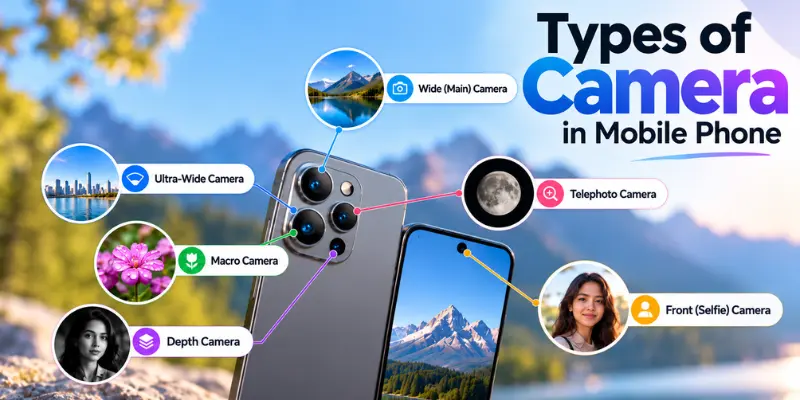
1. Main or Wide Camera
The main camera or wide camera is the camera that is the default on a phone. It is generally the camera that you use when you just want to take a picture by launching the camera app. The main camera is good for taking pictures of anything in general, but is most often used for people, pets, food, landscapes, and buildings. It can also function well in varying lighting conditions.
Many phones actually provide the main camera with the biggest and best sensor because the main camera takes so many pictures for the phone.
Best for: Everyday photos, people, food, buildings, and general photography.
For example, if you are taking a normal picture of your family at home or capturing a photo while travelling, the main camera is usually the first camera you should use.
2. Ultra-Wide Camera
The ultra-wide camera is designed to handle cases where the ordinary camera will not be able to cover everything happening around it. Unlike other cameras that focus on covering a small region, it covers a much larger region compared to other cameras.
It is best suited for landscape photography, large buildings, group photographs, and travel photography. In the case where you find yourself near a large building and you are not in a position to move far enough such that you can capture the whole building, the ultra-wide camera will help you capture more of the building than you would with the ordinary camera.
The room and the landscapes appear larger than with other cameras because of the wide angle. The object near the edges will appear different from those captured using the main camera.
Best for: Landscapes, group photos, buildings, and large scenes.
3. Telephoto Camera
A telephoto camera is designed for photography that requires zooming. The camera allows you to capture images of objects that are farther away without moving closer to them.
What is important about the telephoto camera is its optical zoom technology, which helps preserve more detail than cropping a regular photo. The camera is useful for shooting distant subjects, such as people and buildings.
For example, if you are sitting far from the stage at an event, there is no need to move closer; you can simply use a telephoto camera.
Best for: Portraits from a distance, events, travel photography, and zoomed-in subjects.
4. Periscope Camera
Another form of high-level zoom camera is the periscope camera. This type of camera differs in its internal construction in the phone. It does not take a direct route to pass through the phone from one side to another but uses prisms that bend the light to move across.
This way, it becomes possible to increase the optical path within a compact phone body. Thus, some smartphones can feature an optical zoom level of 5x or even 10x thanks to the periscope camera.
A periscope camera can be especially useful for photographing distant subjects. Wildlife, sports, buildings, and objects far away can benefit from this type of zoom system.
Best for: Long-distance photography and high optical zoom.
5. Macro Camera
The macro camera is designed for taking pictures of very small subjects from a close distance. While the telephoto lens helps you take pictures of objects that are far away, the macro lens does the opposite by allowing you to capture objects close to the camera.
A macro camera helps you take pictures of small subjects such as flowers, insects, and textures that may not be clearly captured using an ordinary camera.
For example, you can capture the fine details of a flower or another small object using a macro camera.
Best for: Close-up photography, flowers, insects, textures, and small objects.
6. Depth Camera or ToF Sensor
A depth camera or ToF (Time-of-Flight) sensor is different from cameras that are mainly used to capture a normal photograph. Its job is to help the phone measure how far objects are from the device.
This depth information can be used to separate a person or object from the background. One common use is portrait mode, where the subject stays sharp while the background appears blurred.
However, not every modern smartphone needs a separate depth camera for this effect. Smartphone software can also create background blur using information from other cameras and image processing.
Best for: Depth information, portrait effects, and separating subjects from backgrounds.
7. Monochrome Camera
The monochrome camera is designed to take photos in shades of gray and black instead of ordinary colors. This type of camera was used on some phones as a secondary camera for capturing contrast and detail.
The monochrome sensor does not create ordinary color photos; instead, it captures shades that go from black to white. It may change the result of photos and is helpful in taking contrast, shape, shadow, and details.
As mentioned above, the monochrome camera is not used on every phone. The reason is that such cameras are not as popular as the primary, ultra-wide, and telephoto cameras.
Best for: Black-and-white photography, contrast, and fine detail.
8. Front or Selfie Camera
The front camera is positioned on the screen side of the smartphone. The main function of the front camera is to enable users to take selfies, make video calls, and shoot videos from the front side of the phone.
Some smartphones have simple front cameras, while some have advanced ones. It all depends on the phone. Also, the front camera can be used in combination with various software options that enhance selfies.
For example, when you switch the camera app to the front-facing view to take a selfie, you are using the front camera. It is also the camera that commonly handles your image during a video call.
Best for: Selfies, video calls, social media videos, and face-focused photos.
How Many Cameras Can a Mobile Phone Have?
The total number of cameras on a smartphone will depend on the phone’s brand and the model. For example, some smartphones will have one rear camera, whereas others will have two, three, and even more cameras that carry out varied functions.
However, having multiple cameras does not mean that each of the cameras is of equal importance. For instance, a smartphone might consist of a primary camera, ultra-wide, and telephoto cameras.
Other specialized cameras such as macro and depth cameras might also be included by some brands in their smartphones. This explains why two smartphones that possess the same number of camera lenses can provide very different photography capabilities.
Why Do Mobile Phones Have Different Types of Cameras?
A single camera lens cannot perform every photography task equally well. A main camera can handle everyday photos, but it cannot provide the same wide field of view as an ultra-wide camera or the same type of optical zoom as a telephoto camera.
Different cameras allow a smartphone to cover more situations without requiring the user to carry a separate camera and different lenses. You can simply switch between cameras depending on what you are trying to photograph.
For example, you might use the main camera for a normal photo, switch to ultra-wide for a landscape, use telephoto for a distant subject, and choose macro when you want to capture something very close.
Main Camera vs Ultra-Wide vs Telephoto vs Macro
The table below gives a quick overview of each camera type’s purpose and uses.
| Camera Type | Main Purpose | Best Used For |
|---|---|---|
| Main or Wide | Normal photography | Everyday photos |
| Ultra-Wide | Wider field of view | Landscapes and groups |
| Telephoto | Optical zoom | Distant subjects |
| Periscope | High-level optical zoom | Far-away subjects |
| Macro | Close-up focus | Small objects and details |
| Depth / ToF | Measures distance | Portrait effects |
| Monochrome | Black-and-white images | Contrast and detail |
| Front / Selfie | Front-facing photography | Selfies and video calls |
Does More Camera Mean Better Camera Quality?
More lenses in the phone’s camera do not automatically guarantee higher-quality pictures because each of the lenses serves a different purpose, while other factors like the image processor and stabilization play an integral part in creating the final picture.
For example, a phone with three functional cameras is likely to be more efficient than a phone with four cameras that may lack practicality for some lenses.
So, rather than asking only “How many cameras does this phone have?”, it is better to ask “What can each camera do?” This gives you a clearer idea of whether the phone’s camera system is suitable for your needs.
Conclusion
So guys, in this article, we’ve covered the different types of mobile phone cameras in detail. Each camera serves a different purpose, from taking everyday photos to capturing distant subjects and close-up details.
In my opinion, you should focus on camera quality and features rather than simply counting the number of cameras on a phone.
Choose a smartphone that suits your photography needs and budget. If you found this guide helpful, share it with others and explore more mobile phone guides on our website.
Frequently Asked Questions (FAQs)
Here are answers to some common questions about mobile phone camera types :
The primary camera is the main rear camera used for most everyday photos. Secondary cameras provide additional features, such as a wider field of view, optical zoom, or close-up photography.
Optical zoom uses the camera’s optical system to magnify a subject, helping preserve image detail. Digital zoom enlarges a portion of an image through cropping and processing, which can reduce detail at higher zoom levels.
Some smartphones use two front cameras to offer different fields of view or additional photography features. For example, one camera may capture a standard selfie, while the other captures a wider group selfie.
No, dedicated macro and depth cameras are not always necessary. Some smartphones use their main cameras, autofocus systems, software, or other sensors to provide close-up photography and portrait effects.
Autofocus is a feature that automatically adjusts the camera’s focus to make a subject appear sharp. It is useful for photographing people, moving subjects, and close-up objects.



- Be Respectful
- Stay Relevant
- Stay Positive
- True Feedback
- Encourage Discussion
- Avoid Spamming
- No Fake News
- Don't Copy-Paste
- No Personal Attacks
- Be Respectful
- Stay Relevant
- Stay Positive
- True Feedback
- Encourage Discussion
- Avoid Spamming
- No Fake News
- Don't Copy-Paste
- No Personal Attacks
