Android Phone Touchscreen Not Working? 10 Easy Fixes
Published: 7 Aug 2026
Is your Android phone touchscreen not working, responding slowly, or ignoring your taps? You may be unable to unlock your phone, answer calls, type messages, open apps, or access important files.
Don’t worry—many touchscreen problems are caused by temporary software glitches or minor issues that you can fix yourself without professional repair.
In this guide, you will learn why an Android phone touchscreen stops working, 10 important ways to fix it, and when you should take the phone to a repair centre. Without wasting time, let’s dive in
Why Is My Android Phone Touchscreen Not Working?
An Android phone touchscreen can stop working due to software issues, hardware damage, or external factors.
Software problems are usually temporary and may happen because of frozen apps, system bugs, outdated Android software, low storage space, or problematic applications.
Hardware issues are more serious and can occur due to drops, water damage, a damaged display, loose connections, a faulty replacement screen, or a swollen battery.
Common causes include:
- Dirt, oil, or moisture on the screen
- Damaged or poor-quality screen protector
- Tight or incorrectly fitted phone case
- Faulty charger or charging cable
- Frozen or unresponsive apps
- Outdated Android software
- Problematic third-party apps
- Low internal storage
- Cracked display
- Water damage
- Loose display connector
- Damaged touch digitizer
- Faulty replacement screen
- Swollen battery

Common Android Touchscreen Problems
Touchscreen issues can appear in different ways. Identifying the type of problem can make troubleshooting much easier.
1. The Entire Screen Is Not Responding
The display turns on normally, and you can receive calls or notifications, but the screen does not respond to any touch input.
This problem is often caused by a temporary software crash, a frozen system, or damage to the touchscreen hardware.
2. Part of the Screen Is Not Working
Only one section of the display—such as the top, bottom, left, or right side—responds to touch, while the rest remains unresponsive.
This usually indicates damage to the touch digitizer or display assembly, especially if the phone was recently dropped.
3. The Screen Responds Slowly
The touchscreen works, but there is a noticeable delay between your touch and the phone’s response.
This may happen when the phone is overheating, running low on available storage, or struggling with too many apps running in the background.
4. The Screen Freezes Randomly
The touchscreen works normally for a while and then suddenly becomes unresponsive before working again.
A software bug, insufficient memory, or a problematic app is often responsible for this issue.
5. The Touchscreen Stops Working While Charging
If the touchscreen becomes inaccurate, delayed, or completely unresponsive only while charging, the charger or cable may be the cause.
Low-quality chargers, damaged charging cables, grounding issues, or a dirty charging port can interfere with normal touchscreen operation.
Test Your Android Touchscreen
Now that you know the possible causes, it’s a good idea to test your touchscreen before trying the fixes below. This will help you determine whether the problem affects the entire screen or only specific areas.
Use our Touch Screen Test Tool to check every part of your phone’s display. If some areas don’t respond while others work normally, the issue is likely related to the touch digitizer or display rather than a software issue.
👉 Test Your Android Touchscreen with Our Touch Screen Test Tool
How to Fix Android Phone Touchscreen Not Working
Try out these 10 fixes one by one and test the touchscreen after each of these so that you know what went wrong.
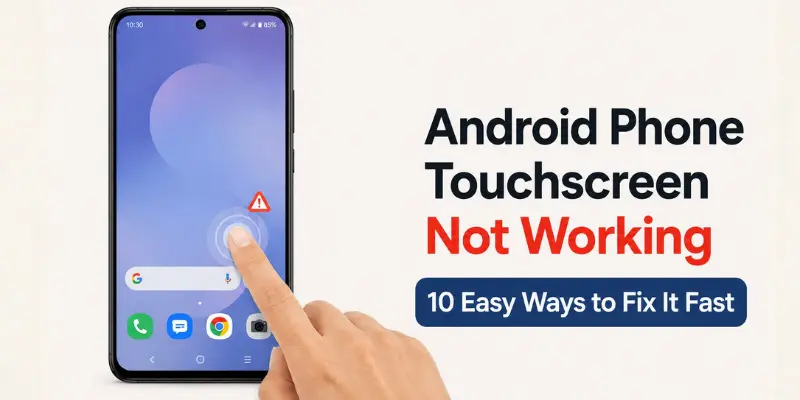
1. Clean and Dry the Screen
A dirty screen will not detect finger inputs. Turn off the phone and wipe its screen with a microfiber cloth.
Make sure:
- The screen is completely dry
- Your hands are clean and dry
- There is no oil or lotion on your fingers
- No water is trapped around the screen edges
- The phone is not covered with dust
If the screen is greasy, slightly dampen the microfiber cloth with water and clean it gently. Do not spray water or cleaning solutions directly onto the phone, as liquid can damage internal components.
Avoid using harsh chemicals, abrasive materials, or rough cloths because they may damage the screen coating.
In case your phone gets wet from rain or steam, turn it off and let it dry. Never charge a wet phone because it can cause further damage.
2. Remove the Screen Protector and Phone Case
A damaged or poorly installed screen protector can reduce touch sensitivity.
The protector may cause problems if:
- It is cracked
- It is too thick
- It has air bubbles
- Dust is trapped underneath
- It is lifting from the corners
- It is not aligned correctly
- It is made for another phone model
Carefully remove the screen protector and test the touchscreen again. You should also remove the phone case because a tight or damaged case may press against the screen edges or side buttons, especially on phones with curved displays.
If the touchscreen works normally after removing the protector or case, replace it with a high-quality option designed specifically for your phone model.
3. Disconnect the Charger
If your touchscreen stops working while charging, unplug the phone immediately.
A faulty or low-quality charger can create electrical interference that affects the touchscreen.
Try the following:
- Use the original charger
- Test a certified replacement charger
- Change the charging cable
- Try another wall socket
- Check the charging port for dirt
- Avoid using the phone while charging
Stop using the charger immediately if it becomes unusually hot, makes strange noises, produces sparks, or causes your touchscreen to behave incorrectly.
If the touchscreen works normally after disconnecting the charger, the issue may be related to the charger, cable, power outlet, or charging port.
4. Force Restart the Android Phone
A temporary software glitch can cause the touchscreen to freeze or stop responding. If the screen still responds, try holding the Power button and selecting “Restart” or “Reboot“. If the screen is completely frozen, use a force restart instead.
On many Android phones:
- Press and hold the Power and Volume Down buttons together.
- Keep holding them for around 10 to 20 seconds.
- Release the buttons when the phone restarts or the brand logo appears.
The button combination may vary depending on your phone model.
The force restart process does not usually remove any of your applications, images, videos, or other documents stored on your phone.
5. Let the Phone Cool Down
Overheating can make an Android touchscreen slow, delayed, or unresponsive.
Your phone may overheat while:
- Playing heavy games
- Recording long videos
- Charging
- Using GPS navigation
- Running multiple apps
- Using the camera for extended periods
- Sitting in direct sunlight
Stop using the phone and disconnect the charger. Remove the phone case and place the device in a cool, dry area.
Do not put the phone in a refrigerator or freezer, as sudden temperature changes can cause moisture to form inside the device.
Wait until the phone returns to a normal temperature, then test the touchscreen again.
6. Update Android and Installed Apps
A software bug may affect touchscreen performance. Phone manufacturers regularly release updates to fix bugs, improve system stability, and resolve compatibility issues.
To update Android, go to:
Settings > System > Software Update
Depending on the phone brand, the option may appear under:
- About Phone
- System Update
- Software Information
- Security and Updates
Install any available updates and restart the phone.
You should also update all installed apps through the Google Play Store.
If the touchscreen freezes only while using one app, try:
- Force stopping the app
- Updating it
- Clearing its cache
- Uninstalling and reinstalling it
- Using another similar app
If the screen works normally everywhere except one application, the app may be responsible rather than the display.
7. Remove Recently Installed Apps
A recently installed application may create system conflicts or cause the phone to freeze. This is more likely if the touchscreen problem started immediately after installing a new app.
Remove recently installed applications, especially:
- Third-party keyboards
- Screen filters
- Launchers
- Cleaning apps
- Battery-saving apps
- Gaming tools
- Touch-control apps
- Screen recorders
- Apps installed outside the Play Store
Restart your phone after removing the apps.
If the touchscreen works normally afterward, one of the removed apps was likely causing the problem.
To reduce the risk of future issues, install apps only from trusted sources and avoid those that request unnecessary permissions.
8. Test the Phone in Safe Mode
Safe Mode temporarily disables downloaded apps. It helps you check whether a third-party application is causing the touchscreen problem.
A common method is:
- Press and hold the Power button until the power menu appears.
- Touch and hold the “Power Off” option.
- Tap “Safe Mode” when prompted.
- Wait for the phone to restart.
The words “Safe Mode” may appear at the bottom of the screen. Once the phone restarts, use it for a few minutes and test the touchscreen.
If the touchscreen works normally in Safe Mode, a downloaded app is likely causing the problem. Restart your phone normally and uninstall recently installed apps one at a time.
If the touchscreen still doesn’t work, the issue is likely related to the Android system or the phone’s hardware. The steps to enter Safe Mode may vary depending on your phone model or manufacturer.
9. Free Up Internal Storage
Low internal storage can slow down your phone, cause apps to freeze, and reduce overall performance.
To check your available storage, go to:
Settings > Storage
Try to keep at least 10% to 20% of your phone’s storage free.
You can free up space by deleting:
- Unused apps
- Large games
- Old videos
- Duplicate photos
- Downloaded files
- Offline movies
- App cache
- Unnecessary documents
- WhatsApp media
After freeing up storage, restart your phone and test the touchscreen again.
10. Back Up and Factory Reset the Phone
A factory reset should be your final software troubleshooting step. It removes all installed apps, accounts, settings, and personal files from your phone.
Before resetting your phone, back up your:
- Photos and videos
- Contacts
- Documents
- WhatsApp chats
- Account information
- Important app data
On most Android phones, you can find the factory reset option by going to:
Settings > System > Reset Options > Erase All Data
The exact steps may vary depending on your phone’s manufacturer.
After the reset, test the touchscreen before reinstalling your apps. If it still doesn’t respond, the problem is likely hardware-related, and the display, touch digitizer, display connector, or another internal component may need repair.
Android Touchscreen Not Working After a Drop
A drop can damage the touchscreen even if the glass does not look badly cracked.
The impact may damage:
- Touch digitizer
- Display connector
- Internal flex cable
- Screen frame
- Battery
- Mainboard components
If the touchscreen stopped working immediately after a drop, software troubleshooting may not solve it.
Back up your files if possible and take the phone to a qualified technician.
Android Touchscreen Not Working After Water Damage
Water can interfere with touch detection and damage the phone’s internal components, even if the screen looks normal.
If the phone becomes wet:
- Turn off the phone.
- Unplug the charger.
- Remove the phone case.
- Wipe the exterior using a soft cloth.
- Place the phone in a dry and well-ventilated area.
- Do not plug in the phone until it is dry.
Avoid using a hairdryer since overheating may damage the phone.
Do not put the phone in rice, as it cannot effectively get the water out, and dust will get into the phone ports.
If the touchscreen still doesn’t work after the phone has dried completely, have it checked by a professional technician.
Android Touchscreen Not Working After Screen Replacement
If the touchscreen problem started after a screen replacement, the new display may be faulty or installed incorrectly.
Possible causes include:
- A low-quality replacement screen
- A loose display connector
- A damaged flex cable
- An incorrect screen model
- Excessive adhesive
- Pressure from the phone frame
- An installation error
Return to the repair shop and ask them to inspect the display. A properly installed replacement screen should respond accurately across the entire display.
How to Use an Android Phone When Touch Is Not Working
If the display still shows an image but does not respond to touch, you may be able to control the phone with a USB mouse.
You will need:
- A USB mouse
- A USB OTG adapter compatible with your phone
Connect the USB mouse to your phone using the OTG adapter. A pointer should appear on the screen, allowing you to:
- Unlock the phone
- Back up files
- Transfer photos
- Open settings
- Save contacts
- Access important documents
This method only works on phones that support USB OTG. It is a temporary solution and does not repair the touchscreen.
When Should You Visit a Repair Centre?
If none of the fixes work, it’s time to seek professional help. Take your phone to a repair centre if:
- The screen is badly cracked.
- Only part of the touchscreen responds.
- The phone has been exposed to water.
- The problem started after a hard drop.
- The screen is lifting from the frame.
- The battery appears swollen.
- The display shows black spots or lines.
- The touchscreen still doesn’t work in Safe Mode.
- The problem continues after a factory reset.
- The issue started after a screen replacement.
- The phone becomes unusually hot.
Back up your important data before taking the phone for repair, if possible. Choose an authorised service centre or a trusted technician who offers a repair warranty.
Tips to Prevent Android Touchscreen Problems
You can reduce the risk of touchscreen problems by following these simple tips:
- Keep the screen clean and dry
- Use an original or certified charger
- Install the correct screen protector
- Use a properly fitted phone case
- Keep Android and apps updated
- Avoid excessive heat
- Do not use the phone with wet hands
- Keep enough storage free
- Protect the phone from drops
- Repair screen cracks early
- Avoid low-quality replacement displays
- Never charge a wet phone
Conlcusion
So guys, in this article, we’ve covered the reasons why an Android phone touchscreen may stop working and the different ways to fix the problem. Most touchscreen issues are caused by software glitches, overheating, faulty accessories, or minor hardware problems, and many of them can be fixed by following the troubleshooting steps in this guide.
I recommend starting with the simplest fixes before considering a factory reset or professional repair, as this can save both time and money. If you found this guide helpful, feel free to explore our other Android troubleshooting articles for more useful tips and solutions.
Frequently Asked Questions (FAQs)
Here are the answers to some common questions about the Android phone touchscreen not working :
Yes. Many touchscreen issues are caused by software or temporary problems that can be fixed at home. Screen replacement is only needed if the hardware is damaged.
A faulty charger, damaged cable, or grounding issue can interfere with the touchscreen. Try using the original or a certified charger.
Yes, if your phone supports USB OTG, you can connect a USB mouse to control the device. This is a temporary workaround.
Yes. Excessive heat can make the touchscreen slow or temporarily unresponsive. Let the phone cool down before using it again.
A factory reset can fix software-related touchscreen issues. It will not repair physical or water damage.





- Be Respectful
- Stay Relevant
- Stay Positive
- True Feedback
- Encourage Discussion
- Avoid Spamming
- No Fake News
- Don't Copy-Paste
- No Personal Attacks
- Be Respectful
- Stay Relevant
- Stay Positive
- True Feedback
- Encourage Discussion
- Avoid Spamming
- No Fake News
- Don't Copy-Paste
- No Personal Attacks
