LTPO Display Explained: Benefits, Drawbacks & How It Works
Published: 2 Nov 2026
Smartphone displays are becoming smoother and more power-efficient with newer technologies. One of these technologies is LTPO, which helps a phone adjust its screen refresh rate depending on what you’re doing. For example, the display can use a lower refresh rate when showing a still image and increase it when you scroll or play games.
But what is an LTPO display, how does it work, and is it better than a regular AMOLED display? Let’s understand its technology, benefits, disadvantages, and differences from other smartphone displays.
What Is an LTPO Display?
LTPO stands for Low-Temperature Polycrystalline Oxide. It is a display backplane technology that helps smartphones adjust their screen refresh rates dynamically. This allows the display to use less power when a high refresh rate isn’t needed.
Unlike traditional display technologies, LTPO combines two types of thin-film transistor (TFT) materials: Low-Temperature Polycrystalline Silicon (LTPS) and oxide semiconductors. This combination helps balance fast display operation with lower power consumption.
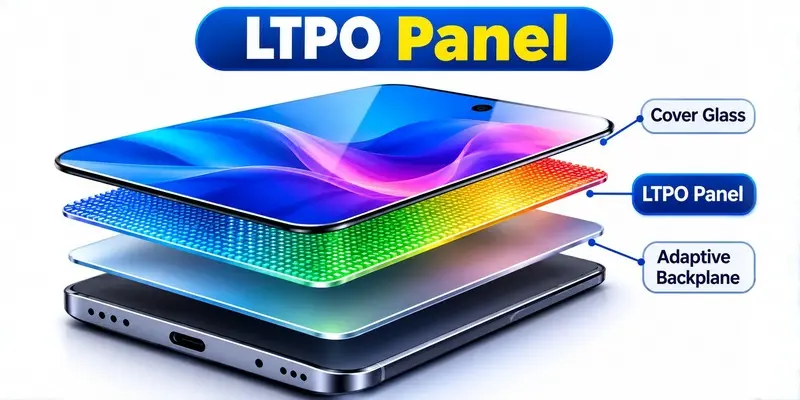
For example, when you’re scrolling through social media, your phone may increase the refresh rate to make movement look smoother. When you’re reading a page or viewing a still image, it can lower the refresh rate to reduce unnecessary power use.
Many modern flagship smartphones use LTPO technology because it supports adaptive refresh rates and can help improve battery efficiency.
How Does LTPO Display Technology Work?
To understand how LTPO works, you first need to know that a smartphone display contains millions of pixels. These pixels are controlled by tiny electronic components called thin-film transistors (TFTs).
LTPO uses a combination of two transistor technologies to control these pixels more efficiently.
1. Low-Temperature Polycrystalline Silicon (LTPS)
LTPS is a type of transistor technology known for its high electron mobility. It allows electrical signals to move quickly through the display circuit, making it useful for high-resolution smartphone screens.
However, LTPS-based circuits can consume more power when maintaining pixel information, particularly at low refresh rates.
2. Oxide Semiconductor (IGZO)
Oxide semiconductors, commonly based on Indium Gallium Zinc Oxide (IGZO), have low leakage current. This means they can retain electrical information with less power being lost while the display is operating.
This property makes oxide transistors useful for reducing power consumption.
3. Combining LTPS and Oxide Technology
LTPO combines the advantages of these two technologies in a hybrid transistor backplane. LTPS provides fast switching, while oxide transistors help reduce leakage current.
Together, they allow the display to support a wider range of refresh rates more efficiently.
How Does Adaptive Refresh Rate Work?
An LTPO display can automatically adjust its refresh rate according to the content on the screen.
For example:
- 1Hz: A very low refresh rate suitable for certain still-screen situations, such as Always-On Display.
- 10Hz: Can be useful when displaying mostly static content.
- 60Hz: Suitable for everyday activities and general screen use.
- 120Hz: Provides smoother movement when scrolling or playing supported games.
These are examples, not fixed settings for every LTPO phone. The available refresh rates depend on the display panel, smartphone manufacturer, and software.
The main advantage is that your phone can lower the refresh rate when screen activity is limited, helping reduce unnecessary power consumption.
What Is LTPO OLED?
LTPO OLED is an OLED display that uses LTPO technology in its transistor backplane.
To understand this combination, it’s helpful to know that OLED and LTPO perform different roles.
OLED (Organic Light-Emitting Diode) is a display technology in which individual pixels produce their own light. It provides deep blacks, strong contrast, and vibrant colors.
LTPO, on the other hand, controls how the display operates through its transistor backplane. It helps the screen adjust its refresh rate while managing power consumption.
When these technologies work together, the result is an LTPO OLED display that combines OLED picture quality with adaptive refresh rate capabilities.
Is LTPO the Same as AMOLED?
No, LTPO and AMOLED are not the same technology.
AMOLED is a type of OLED display technology, while LTPO is a transistor backplane technology used to control the display.
In simple terms:
- AMOLED: Produces images using self-emitting pixels.
- LTPO: Helps control the display and adjust its refresh rate efficiently.
- LTPO AMOLED: Combines both technologies in one display.
This is why smartphone manufacturers use names such as LTPO AMOLED and LTPO OLED in their phone specifications.
Benefits of LTPO Displays
LTPO displays offer several advantages for smartphone users, especially those who want smooth screen performance and better battery efficiency. Here are six important benefits.
1. Dynamic Variable Refresh Rate
LTPO displays can automatically adjust their refresh rate according to screen activity. They use lower refresh rates for static content and higher rates when more movement is needed.
For example, the display can lower its refresh rate while reading an article and increase it when scrolling through social media or playing supported games.
2. Better Battery Efficiency
LTPO technology can reduce unnecessary power consumption by lowering the refresh rate when high-speed screen updates are not needed.
For example, viewing a still image does not require 120Hz. The display can switch to a lower refresh rate, helping save power and potentially extend battery life.
3. More Efficient Always-On Display
Always-On Display (AOD) shows information such as the time, date, and notifications while your phone is locked.
Some LTPO displays can reduce their refresh rate to as low as 1Hz when showing static information. This helps keep important details visible while reducing unnecessary power consumption.
4. Smoother Scrolling and Gaming
Many LTPO smartphones support refresh rates of up to 120Hz, making scrolling, animations, and supported games look smoother than on standard 60Hz displays.
You can notice the difference when browsing websites, switching between apps, or scrolling through social media feeds.
5. Fast Pixel Switching
LTPO combines LTPS and oxide transistor technologies. LTPS provides high electron mobility, helping electrical signals move quickly through the display circuit, while oxide transistors help reduce leakage current.
Together, they support responsive display performance with better power efficiency.
6. Flexible Refresh Rate Control
LTPO technology allows compatible displays to support different refresh rates, such as 1Hz, 10Hz, 30Hz, 60Hz, and 120Hz, depending on the panel and software.
This flexibility helps the phone choose a suitable refresh rate for different activities instead of constantly maintaining a high refresh rate.

Disadvantages of LTPO Displays
Although LTPO displays offer better refresh rate control and power efficiency, they also have a few drawbacks you should consider before choosing an LTPO smartphone.
1. Higher Manufacturing Cost
LTPO displays use a more complex transistor backplane that combines LTPS and oxide technologies. This makes their manufacturing process more complicated than that of many conventional display panels.
As a result, LTPO screens can be more expensive to produce and are commonly found in premium and flagship smartphones.
2. Limited Availability
LTPO technology is not available in every smartphone. It is more commonly used in premium devices, while many budget and mid-range phones still use conventional OLED, AMOLED, or LCD panels.
If you specifically want an LTPO display, you may have fewer smartphone options, particularly in lower price ranges.
3. Battery Savings Are Not Always the Same
Although LTPO technology can reduce display power consumption, it does not guarantee significantly longer battery life in every smartphone.
Actual savings depend on screen brightness, refresh rate settings, software optimization, and daily usage. Other components, such as the processor and mobile network, also affect battery consumption.
4. Limited Refresh Rate Options on Some Displays
Not all LTPO displays support the same refresh rate range. Some panels can reduce their refresh rate to 1Hz, while others have a higher minimum refresh rate.
The available refresh rates depend on the display panel, smartphone manufacturer, and software. Therefore, having an LTPO display does not automatically mean a phone supports every refresh rate, such as 1Hz to 120Hz.
LTPO Display vs AMOLED: What’s the Difference?
LTPO and AMOLED are different technologies, so they aren’t direct alternatives to each other.
AMOLED produces images using self-emitting pixels, while LTPO controls the display’s transistor backplane and supports efficient refresh-rate adjustments.
Here’s a simple comparison:
| Feature | LTPO | AMOLED |
|---|---|---|
| Technology | Transistor backplane technology | Display technology |
| Main purpose | Controls pixels and refresh rate | Produces images using self-emitting pixels |
| Battery efficiency | Can reduce power consumption through adaptive refresh rates | Depends on panel design, brightness, and displayed content |
| Refresh rate | Supports adaptive refresh rates on compatible panels | Depends on the backplane and display implementation |
| Picture quality | Does not directly determine picture quality | Provides deep blacks, high contrast, and vibrant colors |
| Can they work together? | Yes | Yes |
Which One Is Better?
You don’t necessarily have to choose between LTPO and AMOLED because they can work together.
An LTPO AMOLED display combines AMOLED picture quality with LTPO’s adaptive refresh-rate capabilities.
If you’re comparing a regular AMOLED phone with an LTPO AMOLED phone, The LTPO model may offer better display power efficiency, particularly when its refresh rate drops while displaying static content.
However, image quality also depends on other factors, such as brightness, resolution, color accuracy, and panel quality.
LTPO vs LTPS: What’s the Difference?
LTPO and LTPS are two display backplane technologies used in modern smartphones. Both use thin-film transistors (TFTs) to control display pixels, but they differ in the materials and transistor technologies they use.
LTPS (Low-Temperature Polycrystalline Silicon) uses polycrystalline silicon transistors that offer high electron mobility. This allows electrical signals to move quickly through the display circuit, making LTPS suitable for high-resolution and responsive screens.
LTPO (Low-Temperature Polycrystalline Oxide) combines LTPS and oxide transistor technologies. LTPS provides fast switching, while oxide transistors help reduce leakage current and improve power efficiency during low-refresh-rate operation.
| Feature | LTPO | LTPS |
|---|---|---|
| Full form | Low-Temperature Polycrystalline Oxide | Low-Temperature Polycrystalline Silicon |
| Technology | Combines LTPS and oxide transistors | Uses polycrystalline silicon transistors |
| Power efficiency | Can offer better efficiency at low refresh rates | Generally consumes more power during low-refresh-rate operation |
| Refresh rate | Supports a wide adaptive refresh rate range on compatible panels | Can support fixed or variable refresh rates, depending on implementation |
| Manufacturing cost | Generally more complex and expensive | Generally simpler and less expensive |
| Common use | Premium and flagship smartphones | Various smartphone display panels |
Which Is Better: LTPO or LTPS?
If you want a smartphone with better adaptive refresh rate control and improved display power efficiency, LTPO is generally the better choice. It can lower the refresh rate when you are reading or viewing static content and increase it when you scroll or play supported games.
However, LTPS is also a good display technology. It offers fast pixel control and responsive performance, making it suitable for everyday smartphone use. It can also support variable refresh rates, depending on the display design.
In simple terms: Choose LTPO if you want more flexible refresh rate control and better power efficiency at lower refresh rates. LTPS is still a practical option if you want a responsive display without necessarily needing LTPO technology.
Is an LTPO Display Worth It?
Whether an LTPO display is worth it depends on your budget, smartphone usage, and display preferences. Here are some situations to help you decide.
An LTPO Display Is Worth It If:
- You want better battery efficiency: It can lower the refresh rate during static content to reduce display power consumption.
- You prefer smoother scrolling: Many LTPO phones support up to 120Hz for smoother scrolling and animations.
- You use Always-On Display: Compatible panels can use very low refresh rates to save power while showing basic information.
- You want adaptive refresh rates: The display can adjust its refresh rate according to screen activity.
An LTPO Display May Not Be Necessary If:
- You have a limited budget: A good non-LTPO phone may offer better value.
- You use your phone for basic tasks: A standard display may be enough for calls, messaging, and browsing.
- You care about picture quality: Brightness, resolution, and color accuracy also matter when choosing a display.
In short: Choose LTPO if you want flexible refresh-rate control and better power efficiency. Otherwise, a good-quality non-LTPO display may be enough for everyday use.
Which Phone Models Have LTPO Displays?
Many premium smartphones use LTPO displays with adaptive refresh rate technology. Here are some popular models from different brands:
- Apple iPhone 18 Pro Max: Features an LTPO OLED display with ProMotion technology and an adaptive refresh rate of up to 120Hz.
- Samsung Galaxy S26 Ultra: Comes with a Dynamic LTPO AMOLED 2X display supporting an adaptive refresh rate of up to 120Hz.
- Google Pixel 10 Pro XL: Features a 6.8-inch LTPO OLED display with a 1–120Hz refresh rate.
- OnePlus 15: Uses a 6.78-inch LTPO AMOLED display with a refresh rate of up to 165Hz.
- Xiaomi 17 Ultra: Features an LTPO OLED display with an adaptive refresh rate of up to 120Hz.
These are some examples of smartphones with LTPO displays. Available features and refresh rates may vary by model and region.
Conclusion
So guys, in this article, we’ve covered LTPO displays in detail. You now understand how LTPO works, its benefits and drawbacks, and how it differs from AMOLED and LTPS.
My recommendation is to consider an LTPO smartphone if you want flexible refresh rate control and better display power efficiency. However, if you mostly use your phone for daily tasks, a good-quality non-LTPO display may be enough.
If you found this article helpful or have any questions, feel free to share your thoughts in the comments below!
Frequently Asked Questions
Here are answers to some common questions about LTPO screens.
No display technology is better than LTPO in every situation. OLED and AMOLED focus on picture quality, while LTPO improves refresh rate control and power efficiency. The best choice depends on your needs, budget, and display preferences.
LTPO and OLED serve different purposes, so they are not direct alternatives. OLED produces images using self-emitting pixels, while LTPO controls the display through its transistor backplane. An LTPO OLED combines both technologies for picture quality and adaptive refresh rates.
LTPO and AMOLED are different technologies, so neither is directly better than the other. AMOLED produces images, while LTPO helps control refresh rates efficiently. An LTPO AMOLED display combines both technologies.
Yes, an LTPO display can save battery by lowering its refresh rate when high-speed updates are unnecessary. This reduces display power consumption during activities such as reading or viewing static content. Actual savings depend on brightness, software, and phone usage.
Yes, some LTPO displays can reduce their refresh rate to 1Hz. This helps save power when showing static information on an Always-On Display. However, not every LTPO phone supports a 1Hz minimum refresh rate.
Yes, LTPO can provide smoother gaming when the phone supports a high refresh rate. It helps compatible games run with smoother visuals and adjusts the refresh rate according to screen activity.




- Be Respectful
- Stay Relevant
- Stay Positive
- True Feedback
- Encourage Discussion
- Avoid Spamming
- No Fake News
- Don't Copy-Paste
- No Personal Attacks
- Be Respectful
- Stay Relevant
- Stay Positive
- True Feedback
- Encourage Discussion
- Avoid Spamming
- No Fake News
- Don't Copy-Paste
- No Personal Attacks
