History of Mobile Phones: How Phones Changed Our Daily Lives
Published: 18 Sep 2026
Imagine carrying a phone that weighs nearly a kilogram and can do little more than make calls. Hard to believe, right? Yet, this was the reality of early mobile phones.
Today, smartphones help us communicate, capture photos, browse the internet, and manage everyday tasks. But how did these bulky devices evolve into powerful pocket-sized computers?
In this article, we’ll explore the history of mobile phones, from the first handheld call to modern smartphones, 5G networks, advanced cameras, and AI-powered features.
Early Beginnings of Mobile Phones
The concept of mobile communication did not originate from contemporary smartphones. It was during the 1940s that engineers and telephone corporations tested devices that could enable people to communicate without having to use a fixed telephone line.
The devices utilized radio waves to connect calls. They were bulky, expensive, and energy-intensive. Furthermore, they could be used by a few users at any one time. Despite these shortcomings, these early devices laid the foundation for future mobile phones.
Mobile Phones in Vehicles
In the early days, mobile phones had applications in cars and other vehicles. This meant that the phone system was fitted in the car, which could not be portable like today’s phones. One could use the phones to talk while on the move, but they could not be adopted by everyone.
This proved that it is possible to communicate when moving from one place to another. The phones also contributed to the development of future mobile phones.
The First Handheld Mobile Phone
The first handheld mobile phone was a major step in the history of mobile phones. Before this, mobile communication systems were mainly used in vehicles. A handheld phone gave people the freedom to carry a phone with them and make calls from different places.
Who Invented the First Mobile Phone?
The invention of the first handheld mobile phone and calling device is credited to Martin Cooper, an engineer working for Motorola Corporation. He made his first public call on 3 April 1973 in New York City using a Motorola prototype phone. Although the phone was big and heavy by comparison to today’s smartphones, it proved the possibility of a portable mobile phone.
Motorola DynaTAC 8000X
Motorola did not stop developing handheld phones after the 1973 demonstration. In 1983, the Motorola DynaTAC 8000X was introduced as the first commercially available handheld mobile phone. This phone was costly and quite bigger than the present-day phones, but one could carry his cellular phone out of the car for the first time.

The Rise of Mobile Phones in the 1980s and 1990s
The 1980s and 1990s marked an important era in the evolution of the mobile phone industry. This is when mobile phones began changing from bulky and costly means of communication into smaller and more affordable phones. Improvements were made through network technology and by manufacturers who worked to develop smaller, lighter, and more affordable phones.
During this era, various phone features were added that revolutionized the manner in which the mobile phone was used. Voice calling was the primary function of mobile phones, but other features such as text messaging, games, and address books were added.
1G Mobile Networks
The first generation of cellular networks was called 1G. These networks started appearing commercially in the late 1970s and became more common during the 1980s. 1G mainly supported analog voice calls, which allowed people to make calls while away from a fixed telephone.
Early 1G phones were still expensive and large. They were mostly used by businesses and people who could afford them. However, 1G proved that mobile communication could work on a much larger scale. It created the foundation for the mobile networks that came later.
Mobile Phones Become Smaller
It did not take long before phone manufacturers had one primary aim: to make mobile phones more portable. Improved batteries and the miniaturization of electronic components made this possible.
This was very significant because users no longer needed to carry bulky devices or keep their phones in the car. They could use their phones while traveling, shopping, working, or hanging out with friends. Mobile phones were also becoming cheaper to manufacture.
The Rise of 2G and Text Messaging
The arrival of 2G, or second-generation mobile networks, brought another major change. Unlike 1G, 2G used digital technology. It improved call quality and allowed networks to support more users.
2G also introduced services that became a normal part of mobile phone use. One of the most important was SMS text messaging. People could communicate through text messaging without making phone calls. This simple feature changed daily communication, giving people an easier way to connect.
Other mobile phone features included contact lists, calendars, alarm clocks, games, basic cameras, and customized ringtones. The mobile phone was becoming more than just a telephone.
The Nokia Era
During the late 1990s and early 2000s, Nokia became one of the most recognized names in the mobile phone industry. Nokia phones were popular because they were simple, durable, and easy to use. Many models also offered long battery life.
The Nokia 3310 became one of the best-known examples. Its simple design, useful features, and strong build made it popular with people around the world.
By the end of the 1990s, mobile phones had evolved quite a lot. They had become more compact, practical, and affordable for more people. This paved the way for the next revolution in mobile technology.
The Smartphone Revolution
One of the most significant revolutions in the history of cell phones came in the late 2000s. Cell phones were no longer restricted to making calls and sending text messages alone. The advent of touch screens, mobile internet, advanced software, and downloadable applications changed everything.
The Introduction of the iPhone
In 2007, Apple introduced the first iPhone. It brought a phone, music player, internet browser, and other features together in one touchscreen device.
Multi-touch technology was another feature that became popular because of the iPhone. Users could use their fingers to control the phone through taps and swipes. The phone differed greatly from other devices which were operated primarily using physical keys and buttons.
The iPhone was not the first smartphone. But it was one of the factors that contributed greatly to the transformation of mobile phones as we know them today. A phone could become something like a mini-computer that could be taken anywhere.
Android Enters the Market
In 2008, the first commercial Android phone became available. Android gave phone manufacturers a flexible operating system that they could use on different devices.
This helped create more choices for smartphone users. Android phones started becoming available from various brands and at various price points. Some phones had cameras as their selling point, while some had bigger screens.
The popularity of Android allowed even more users access to smartphones. Together, Android and iOS have become dominant platforms for smartphones.
The App Revolution
Apps made smartphones even more useful. Instead of using only the features that came with a phone, users could download new apps for different needs.
For example, you could install a map app to find a place, a banking app to manage money, or a video app for entertainment. Apps also became useful for education, shopping, fitness, photography, games, and work.
It transformed the function of the mobile phone. It was no longer just used for communication purposes only. It was a computer, which could help in doing several things through different applications.
This helped shape the mobile devices and smartphone experiences we have today. As smartphones became more powerful and mobile networks became faster, new uses for mobile phones continued to appear in our daily lives.
The Development of 3G, 4G and 5G
The increased utility of mobile phones was possible thanks to advanced mobile networks. The transition from 2G to 3G, 4G, and 5G technologies made it possible for the internet to become even faster and provided an increasing number of uses for mobile devices.
3G Technology
The third generation of mobile networks is known as 3G. This technology provided an improved internet experience compared to that offered by the previous technologies.
The significance of this advancement was that mobile phones were no longer limited to voice calls and text messaging. They were beginning to become useful tools for accessing the internet.
4G LTE Technology
4G LTE made mobile internet much faster. This made it possible for smartphones to deal with tasks like streaming videos in HD quality, video calling, online gaming, using social networks, and getting directions in real time.
With 4G LTE, users could watch videos, browse maps, and access online content with less waiting time. It made everyday internet activities faster and more convenient, even while people were on the move.
5G Technology
5G is the latest major generation of mobile network technology. It is designed to offer faster speeds, reduced delay, and increased network capacity in certain regions.
These improvements can support smoother video streaming, better device connectivity, and more reliable cloud-based services. As 5G networks continue to expand, smartphones will be able to handle more demanding online activities while users are on the move.
How Smartphones Have Changed
The smartphone technology has evolved greatly from the days when mobile phones were introduced. The smartphones in today’s era are more advanced than their predecessors. These smartphones have computing capabilities and functions such as those of a computer, camera, GPS system, and music player.
The greatest evolution in smartphones has been brought about by improvements in hardware, displays, and cameras.
Smartphone Hardware
Modern smartphones have powerful processors that help them run apps and perform many tasks quickly. They also include features such as fingerprint sensors, face recognition, GPS, Wi-Fi, Bluetooth, NFC, fast charging, and wireless charging.
Battery technology has also improved. Modern phones can support many hours of daily use and charge much faster than older mobile phones.
A good example is mobile gaming. Older phones could run only simple games, while modern smartphones can run games with detailed graphics and complex controls.
Mobile Phone Displays
Phone screens have changed from small, simple displays to large and bright touchscreens. Early phones often used small monochrome screens, while later devices introduced color LCD displays.
Modern smartphones can use technologies such as OLED, AMOLED, and LTPO OLED. These screens can provide better colors, stronger contrast, higher resolution, and smoother movement.
Displays with high refresh rates also result in smooth scrolling and animations. This makes the display easier to enjoy while viewing movies, gaming, web surfing, and applications.
Mobile Phone Cameras
Mobile phone cameras have changed greatly over the years. Early phone cameras were mainly useful for taking simple photos, while present-day smartphones can capture detailed photos and high-quality videos.
Many smartphones have multiple cameras, such as a primary, ultra-wide, and telephoto camera. Each camera is designed for different types of photos.
Image processing software can also improve night photos, portraits, colors, and video stabilization. Smartphones have made photography more convenient without the need for a separate camera.
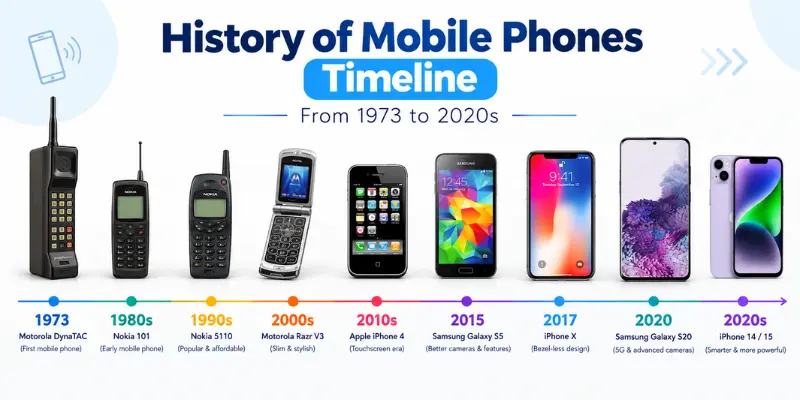
History of Mobile Phones Timeline
The history of mobile phones includes many important moments. Each step brought new technology and made phones easier and more useful. Here is a simple timeline of the major changes:
| Year | Major Development |
|---|---|
| 1940s | Early mobile telephone systems were developed for vehicles. |
| 1960s | Mobile communication systems and cellular network ideas improved. |
| 1973 | Martin Cooper made the first public handheld mobile phone call. |
| 1983 | Motorola DynaTAC 8000X became commercially available. |
| 1980s | 1G cellular networks started expanding. |
| 1990s | 2G digital networks and SMS became important. |
| 1990s | Mobile phones became smaller and more affordable. |
| Late 1990s | Phone cameras and early mobile internet features started appearing. |
| Early 2000s | Smartphones and mobile internet became more advanced. |
| 2007 | Apple introduced the first iPhone. |
| 2008 | The first commercial Android phone became available. |
| 2010s | 4G, app stores, touchscreen phones, and mobile photography grew quickly. |
| 2020s | 5G, advanced cameras, AI features, and high-refresh-rate displays became common. |
Conclusion
So, guys, it’s time to finish up! In this article, we’ve explored the history of mobile phones and seen how they changed over the years. From large vehicle phones and the first handheld call to modern smartphones, 4G, 5G, and AI features, mobile phones have come a long way.
I recommend that you explore these amazing changes more. You can look at old mobile phones, watch videos about their history, or learn how today’s smartphones work. Don’t forget to share what you learn with your friends and family.
Let’s keep discovering the amazing world of mobile technology together!
Frequently Asked Questions (FAQs)
Here are the answers to some common questions about the history of mobile phones :
From 1973 to 2017, mobile phones evolved from large handheld devices into powerful smartphones. Major developments included the commercial release of the Motorola DynaTAC 8000X, the rise of 2G and SMS, the introduction of the iPhone and Android, and the growth of 3G and 4G mobile internet.
Martin Cooper, an engineer at Motorola, is widely credited with inventing the first handheld mobile phone. He made the first public handheld mobile phone call on April 3, 1973, using a Motorola prototype in New York City.
Here are the five facts about mobile phones.
- Martin Cooper made the first public handheld mobile phone call in 1973.
- The Motorola DynaTAC 8000X became commercially available in 1983.
- 2G networks helped introduce digital mobile communication and SMS.
- Apple introduced the first iPhone in 2007.
- The first commercial Android phone became available in 2008.
Old mobile phones were mainly designed for calls and text messages, while smartphones can perform many tasks similar to a small computer. They can run apps, browse the internet, take photos and videos, use GPS, and connect to various wireless networks.
The IBM Simon is considered one of the first smartphones. It was released in 1994 and combined phone features with a touchscreen, calendar, address book, and email.





- Be Respectful
- Stay Relevant
- Stay Positive
- True Feedback
- Encourage Discussion
- Avoid Spamming
- No Fake News
- Don't Copy-Paste
- No Personal Attacks
- Be Respectful
- Stay Relevant
- Stay Positive
- True Feedback
- Encourage Discussion
- Avoid Spamming
- No Fake News
- Don't Copy-Paste
- No Personal Attacks
