Hard OLED vs Soft OLED: Complete Phone Screen Comparison
Published: 5 Aug 2026
Are you confused about the difference between hard OLED and soft OLED when replacing a phone screen? Both use OLED technology, but their base materials are different. Hard OLED uses a rigid glass substrate, while soft OLED uses a flexible plastic substrate.
This difference affects screen thickness, flexibility, durability, fitting, pressure resistance, and repair cost. Hard OLED is usually cheaper, while soft OLED is generally more flexible and durable.
In this guide, we’ll compare hard OLED vs soft OLED to help you understand their differences and choose the right replacement screen for your phone.
What Is a Hard OLED Screen?
A hard OLED is an OLED display built on a rigid glass substrate. The word “hard” refers mainly to the solid base underneath the display layers. It does not mean the screen is stronger than a soft OLED.
In fact, the rigid OLED panel can be more sensitive to pressure, bending, and impact. The outer glass may remain undamaged while the internal OLED panel develops black spots, colored lines, flickering, or a completely black display.
Hard OLED screens are commonly sold as lower-cost aftermarket replacement screens for phones that originally used OLED displays.
| Advantages of Hard OLED |
|---|
|
| Disadvantages of Hard OLED |
|---|
|
What Is a Soft OLED Screen?
A soft OLED is an OLED panel built on a flexible plastic or polymer substrate instead of a rigid glass base.
LG Display explains that flexible OLED technology uses a plastic substrate rather than the glass substrate used in conventional rigid OLED panels. This construction allows the display to bend and makes the panel thinner and lighter.
In the replacement-screen market, soft OLED is usually treated as a higher-grade aftermarket option. It can flex slightly during installation and is normally less likely to suffer internal OLED damage from light pressure or minor impacts.
However, soft OLED does not mean the front glass is soft. The phone still has a solid outer cover glass that can crack after a drop. The term “soft” refers to the flexible substrate underneath the visible glass.
| Advantages of Soft OLED |
|---|
|
| Disadvantages of Soft OLED |
|---|
|
10 Key Differences Between Hard OLED and Soft OLED
Hard OLED and soft OLED differ in several important areas, including substrate material, flexibility, durability, thickness, fitting, price, and repair quality. The quick comparison table below gives an overview of the main differences before we discuss each point in detail.
| Feature | Hard OLED | Soft OLED |
|---|---|---|
| Substrate Material | Rigid glass substrate | Flexible plastic/polymer substrate |
| Flexibility | Rigid and difficult to bend | Flexible and handles slight bending better |
| Durability | More vulnerable to internal panel damage | Better resistance against internal OLED damage |
| Thickness | Usually slightly thicker | Usually thinner and lighter |
| Screen Fitting | May have minor fitting differences | Usually closer to the original screen design |
| Display Quality | Depends on panel quality and manufacturing | Depends on panel quality and manufacturing |
| Touch Response | Good when properly manufactured | Good and often closer to original performance |
| Price | More affordable | More expensive |
| Installation Risk | Requires careful handling during installation | More flexible and easier to fit |
| Best Use | Budget repairs and older phones | Premium repairs and long-term use |
Now that you’ve seen the quick comparison, let’s explore each difference in detail.
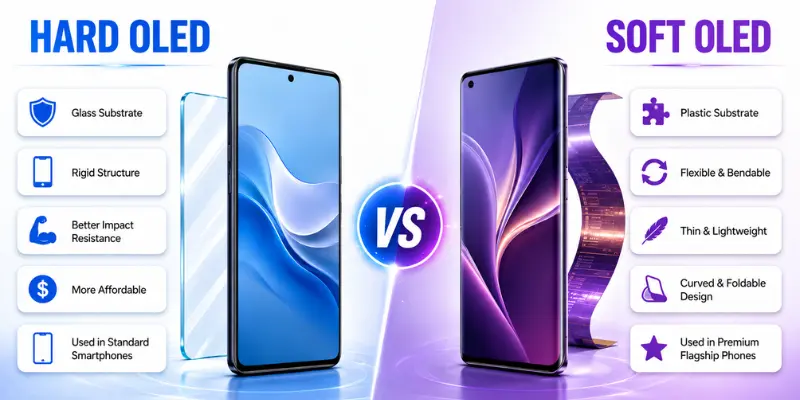
1. Substrate Material
The main difference between hard OLED and soft OLED is the material used as the display’s base.
- Hard OLED uses a rigid glass substrate. This glass holds the OLED display layers in a solid structure.
- Soft OLED uses a flexible plastic or polymer substrate, which allows the display to flex and better absorb pressure than a rigid glass substrate.
This base material affects several other differences, including flexibility, thickness, durability, fitting, and cost.
2. Flexibility
Hard OLED is rigid. It cannot safely bend or flex during installation or daily use.
Soft OLED has a flexible structure. Its flexible structure allows the screen to fit into thinner smartphone frames, helping technicians install it closer to the original display design.
However, soft OLED is not designed to be bent deliberately. The display still contains delicate layers, connectors, and a protective cover glass. Its flexible substrate simply helps reduce the risk of internal panel damage from light pressure or minor bending compared with a hard OLED.
3. Resistance to Drops and Pressure
Soft OLED normally offers better protection against internal panel breakage because its plastic substrate can absorb more movement and pressure than rigid glass.
Hard OLED is more fragile at the panel level. Pressure during installation, sitting on the phone, twisting the frame, or dropping the device may damage the OLED even when the outer glass does not look severely broken. Repair suppliers commonly describe hard OLED as more fragile than soft OLED.
However, neither screen is completely drop-proof. The front glass of both hard and soft OLED assemblies can crack after a strong impact.
A protective case and a properly installed screen protector are useful with either option.
4. Thickness and Weight
A flexible plastic substrate allows soft OLED panels to be thinner and lighter than traditional glass-based OLED panels.
The thinner and lighter construction is one of the key advantages of flexible OLED technology. In comparison, hard OLED panels use a rigid glass substrate, which can make them slightly thicker and less flexible.
The difference may not be noticeable during everyday use, but it can affect how closely the replacement screen fits inside the original phone frame and how similar it feels to the original display.
5. Screen Fitting and Bezel Size
Soft OLED is generally better suited for the curved designs and compact internal layouts of modern smartphones.
Flexible OLED panels can bend near the bottom edge, allowing display components and connectors to fit behind the active screen area. This can help maintain thinner borders and dimensions closer to the original display.
Hard OLED panels cannot bend in the same way. Some aftermarket hard OLED screens may therefore have slightly wider bezels, a larger bottom border, or a minimally smaller active display area. The exact difference depends on the phone model and replacement-screen manufacturer.
Users should check product photos and specifications before buying because not every hard OLED has the same visible-area difference.
6. Display Quality
Both hard OLED and soft OLED use OLED technology. Their pixels produce their own light, allowing them to display deep blacks without a separate backlight.
However, soft OLED does not automatically provide better colors or brightness simply because it uses a flexible substrate.
Display quality also depends on:
- OLED panel grade
- Pixel arrangement
- Resolution
- Maximum brightness
- Color calibration
- Display controller
- Refresh rate
- Polarizer quality
- Manufacturer testing
A high-quality hard OLED may look better than a poorly manufactured soft OLED. Similarly, a premium soft OLED may offer brightness, color, and viewing angles that are closer to the original phone screen.
Always compare the actual replacement-screen specifications instead of judging quality only from the words hard and soft.
7. Touch Response
Both hard OLED and soft OLED screen assemblies include a touch-sensitive digitizer that detects user input.
Both can provide accurate and responsive touch when the screen is manufactured and installed correctly. The substrate alone does not guarantee better touch performance.
Touch response can be affected by:
- Digitizer quality
- Touch-controller compatibility
- Screen refresh rate
- Installation quality
- Flex-cable condition
- Phone software
- Screen protector
- Supplier quality control
Some suppliers market premium soft OLED screens as providing performance closer to the original display. However, a recognized hard OLED from a reliable manufacturer may still provide smooth everyday touch performance.
8. Price
Hard OLED is usually less expensive because rigid glass-based OLED panels are cheaper to manufacture and are commonly positioned as budget-friendly replacement options in the aftermarket repair market.
Soft OLED is generally more expensive because its flexible construction is more advanced and it is often considered a higher-quality aftermarket option that is closer to original-style OLED displays.
The exact price difference depends on several factors, including:
- Phone model
- Screen size
- Refresh rate
- Supplier
- Brand
- Warranty
- Screen grade
- Touch-controller features
Hard OLED can be a practical choice for older phones or budget-focused repairs. Soft OLED is often worth the extra cost for expensive devices, heavy daily use, or users who want better fitting and a replacement screen closer to the original display quality.
9. Installation Risk
Hard OLED requires careful handling during installation.
Excessive pressure, a bent phone frame, leftover glass, uneven adhesive, or force applied to the display can damage the rigid OLED panel. Internal panel damage may appear as:
- Black spots
- Green or colored lines
- Flickering
- Touch problems
- A completely black screen
Soft OLED is more flexible and can handle minor movement better, but it can still be damaged by sharp tools, folded flex cables, excessive heat, or incorrect installation.
Always test the replacement screen before final sealing, and make sure the phone frame is clean, straight, and free from debris before installation.
10. Repair Quality and Best Use
Hard OLED is mainly suitable for a budget-focused screen replacement.
It may be the better choice when:
- The phone has a low resale value.
- The repair budget is limited.
- The phone will be replaced soon.
- The user accepts a higher panel-damage risk.
- A reliable hard OLED is available with a warranty.
Soft OLED is better suited to a higher-quality or longer-term repair.
It may be the better option when:
- The phone originally used a flexible OLED.
- Durability is important.
- The device is expensive.
- The user wants fitting closer to the original screen.
- The phone will be used for several more years.
- The additional repair cost is affordable.
Similarities Between Hard OLED and Soft OLED
Although hard OLED and soft OLED differ in construction, they share several important similarities:
- Both use organic light-emitting diode technology.
- Both produce light at the pixel level.
- Both can display deep black colors.
- Both can provide high contrast.
- Both may support fast response times.
- Both can display bright colors.
- Both can suffer from image retention or burn-in.
- Both include a separate front cover glass in a phone screen assembly.
- Both can be damaged by drops, pressure, water, or poor installation.
Does Hard OLED Have Better Colors Than Soft OLED?
Not necessarily. The glass substrate does not automatically create better colors. Color performance depends on the OLED materials, pixel structure, calibration, display controller, brightness, and manufacturing quality.
Both hard and soft OLED screens can produce deep blacks because their pixels emit light independently.
A premium soft OLED will usually aim to reproduce the original screen’s colors and brightness more closely. However, a high-quality hard OLED may still provide a good viewing experience for normal calling, messaging, browsing, videos, and social media.
Which OLED Screen Is More Durable?
Soft OLED is normally more durable at the internal panel level.
Its flexible plastic substrate can tolerate more movement and impact than the rigid glass substrate used in hard OLED. This reduces the risk of the OLED panel cracking internally after light pressure or a minor drop.
However, soft OLED is not unbreakable. The front glass can crack, the touch layer can fail, and the flex cable can be damaged.
Which OLED Screen Is Better for an iPhone?
Soft OLED is generally the better aftermarket option for an iPhone that originally came with an OLED screen.
It normally provides:
- Better panel flexibility
- Closer fitting
- Lower internal breakage risk
- Thinner construction
- A repair experience closer to the original display
Hard OLED may still be suitable when repair cost is the main concern. It keeps OLED display technology while costing less than soft OLED or an original refurbished screen.
For Pro iPhone models with high refresh rates, check whether the replacement screen supports the phone’s original display features. A screen labeled as soft OLED does not automatically guarantee full compatibility.
Which One Should You Choose?
The right choice depends on your budget, phone model, and repair priorities. Here are the situations where each type is the better option.
Choose Hard OLED If:
- You need the lowest-cost OLED repair.
- The phone is old or has limited resale value.
- You only need the device for basic daily use.
- You understand that the rigid panel is more fragile.
- The supplier offers a reliable warranty.
- A soft OLED repair would cost too much.
Choose Soft OLED If:
- You want better resistance to panel damage.
- You plan to use the phone for a long time.
- The phone is expensive or relatively new.
- You want fitting closer to the original display.
- You prefer a thinner replacement screen.
- You can afford the higher repair price.
Tips and Mistakes to Avoid
Before replacing your phone screen, follow these tips and avoid these common mistakes to achieve the best results.
Useful Tips
- Confirm whether the replacement is hard OLED, soft OLED, LCD, or original refurbished.
- Ask for the screen brand and warranty.
- Check brightness, resolution, and refresh-rate support.
- Test touch response before sealing the phone.
- Inspect the frame for bends and leftover glass.
- Use a protective case after the repair.
- Choose an experienced repair technician.
Mistakes to Avoid
- Assuming hard OLED is stronger just because of its name.
- Believing every soft OLED is an original manufacturer display.
- Choosing a replacement screen based only on the lowest price.
- Ignoring refresh rate and display feature compatibility.
- Applying excessive pressure during screen installation.
- Installing a new screen on a bent or damaged phone frame.
- Comparing screens without checking their quality, specifications, or grade.
- Assuming all aftermarket OLED screens offer the same quality.
Conclusion
So guys, in this article, we’ve covered the difference between hard OLED and soft OLED in detail. Hard OLED is more affordable, while soft OLED usually offers better flexibility, durability, and fitting.
I recommend soft OLED for newer or expensive phones that you plan to use for a long time. Hard OLED can still be a suitable choice for older phones or when you have a limited repair budget.
Before making your final decision, compare the screen quality, warranty, brightness, refresh-rate support, and the supplier’s reputation to choose the best replacement screen for your phone.


- Be Respectful
- Stay Relevant
- Stay Positive
- True Feedback
- Encourage Discussion
- Avoid Spamming
- No Fake News
- Don't Copy-Paste
- No Personal Attacks
- Be Respectful
- Stay Relevant
- Stay Positive
- True Feedback
- Encourage Discussion
- Avoid Spamming
- No Fake News
- Don't Copy-Paste
- No Personal Attacks
