What Is an OLED Display? How It Works, Types & Benefits
Published: 18 Nov 2026
Are you confused about whether an OLED screen is worth the extra money when buying a new smartphone? Many buyers hear about OLED but don’t know what makes it different from a regular LCD screen. They want better colors, deeper blacks, and a good viewing experience without wasting money on the wrong device. Understanding this technology can help you make a smarter choice.
In this beginner-friendly guide, we’ll explain what is oled display and how it works. We’ll also look at its main advantages, disadvantages, differences from other display types, and the things you should consider before buying an OLED device.
Without wasting time, let’s dive in.
What Is an OLED Display?
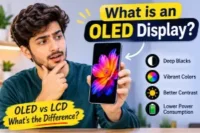
An OLED display is a screen technology that uses organic materials to produce light when electricity passes through them. Each pixel produces its own light, so the screen does not need a separate backlight like a traditional LCD.
The full form of OLED is Organic Light-Emitting Diode. The word “organic” refers to carbon-based materials that manufacturers use inside the display. It does not mean that the screen uses natural or chemical-free materials.
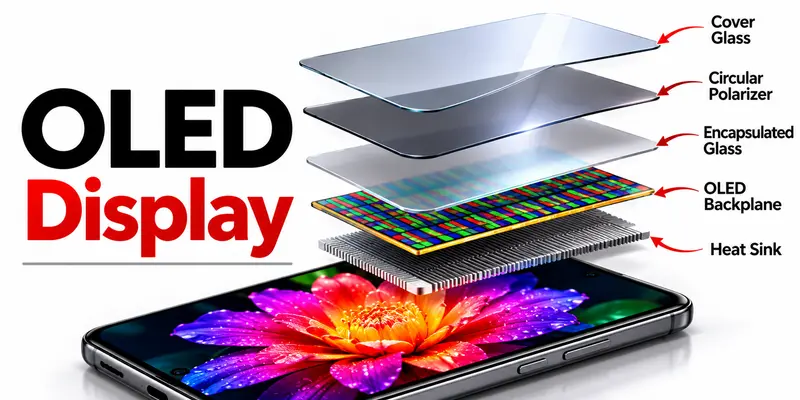
In mobile phones, OLED technology helps create bright images, sharp details, and deep black colors. When a screen displays a black area, the related pixels can turn off completely. This feature allows OLED screens to produce better contrast than many traditional LCD panels.
You can find OLED technology in many modern smartphones, including models from Apple, Samsung, and other manufacturers.
How Does an OLED Display Work?
OLED technology follows a simple process to turn electrical energy into the images you see on your smartphone screen.
Here is how the process works:
- Electricity Supply: When you turn on your smartphone screen, electricity flows through the OLED display’s electronic components.
- Light Production: The electric current passes through organic layers inside the display, causing them to produce light.
- Pixel Control: Each pixel produces its own light. The display controls individual pixels to show different colors and brightness levels.
- Creating Deep Blacks: When the screen needs to display black, the corresponding pixels turn off completely, producing deep black colors.
- Displaying Images: By controlling millions of pixels, the OLED screen creates text, photos, videos, and other images.
As a result, OLED displays produce vibrant colors, deep blacks, and high contrast without needing a separate backlight.
What Are the Advantages of OLED Displays?
OLED technology offers several benefits that can improve your smartphone viewing experience.
| Here are its main advantages: |
|---|
|
What Are the Disadvantages of OLED Displays?
Although OLED technology offers excellent picture quality, it also has some limitations.
| Here are its main disadvantages: |
|---|
|
What Are the Different Types of OLED Displays?
OLED technology comes in different types, each designed for specific uses. Here are the main types of OLED displays:
1. PMOLED (Passive-Matrix OLED)
PMOLED displays use a simple control system to manage pixels through rows and columns. They are generally suitable for smaller screens, such as smartwatches, basic devices, and small electronic displays.
However, they are less suitable for large smartphone screens because they consume more power as screen size and resolution increase.
2. AMOLED (Active-Matrix OLED)
AMOLED displays use thin-film transistors (TFTs) to control individual pixels. This allows them to deliver fast response times, vibrant colors, and high contrast.
They are widely used in modern smartphones, smartwatches, and other electronic devices. Their pixel control system also makes them suitable for larger, high-resolution screens.
3. Flexible OLED
Flexible OLED displays use bendable materials that allow manufacturers to create curved, foldable, and rollable screens. Some use a plastic substrate instead of glass and are known as pOLED (Plastic OLED).
They are commonly used in foldable smartphones and some curved-screen devices.
4. Transparent OLED
Transparent OLED displays allow light to pass through the screen when pixels are not producing light. This makes the display partially transparent while still allowing it to show images.
This technology is mainly used in specialized displays, digital signage, and commercial applications, such as transparent screens in stores and exhibitions.
OLED vs LCD: What’s the Difference?
OLED and LCD are two popular display technologies used in smartphones, TVs, laptops, and other electronic devices. The main difference between them is how they produce light and display images.
OLED displays use self-emissive pixels, meaning each pixel produces its own light. This allows OLED screens to show deep blacks, higher contrast, and vibrant colors.
In comparison, LCD displays use a separate backlight to illuminate the screen, making it harder to produce true black colors.
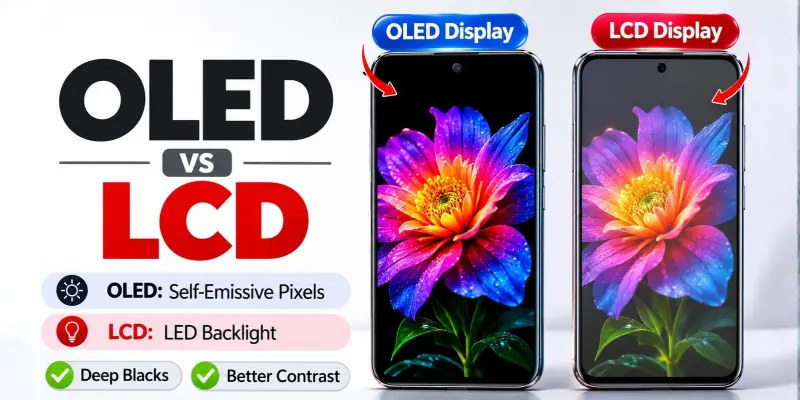
Here is a quick comparison of OLED and LCD displays.
| Feature | OLED | LCD |
|---|---|---|
| Light Source | Each pixel produces its own light. | Uses a separate backlight. |
| Black Levels | Produces deep, true blacks. | Black areas may appear grey. |
| Contrast | Offers higher contrast. | Generally offers lower contrast. |
| Color Quality | Delivers rich and vibrant colors. | Offers good color quality. |
| Response Time | Usually has faster response times. | Usually has slower response times. |
| Viewing Angles | Generally offers wider viewing angles. | Viewing angles depend on panel type. |
| Thickness | Can be thinner and lighter. | Needs extra layers for backlighting. |
| Power Consumption | Can use less power with dark content. | Backlight uses power even with dark content. |
| Price | Generally more expensive. | Usually more affordable. |
| Burn-in Risk | Can experience burn-in with prolonged static content. | Does not typically experience OLED-style burn-in. |
Which Is Better: OLED or LCD?
OLED is generally better for people who want deeper blacks, higher contrast, vibrant colors, and faster response times. It is a good choice for watching movies, gaming, and enjoying high-quality visuals.
LCD is a good option for people who want an affordable display for everyday smartphone use. It can also be a practical choice for users who prefer not to worry about OLED burn-in.
Overall, OLED offers better picture quality, while LCD provides a more budget-friendly option. The best choice depends on your budget and display needs.
Which Smartphones Have OLED Displays?
OLED displays are available in smartphones from several popular brands, including Apple, Samsung, Google, and OnePlus. However, not every smartphone from these brands uses OLED technology. Here are some popular models that feature OLED screens.
Does the iPhone Have an OLED Display?
Yes, many modern iPhones use OLED displays, which Apple markets as Super Retina XDR. These screens deliver deep blacks, vibrant colors, and high contrast.
Some iPhone models with OLED displays include:
- iPhone 18 series
- iPhone 17 series
- iPhone 16 series
- iPhone 15 series
- iPhone 14 series
- iPhone 13 series
- iPhone 12 series
Older models, such as the iPhone 11 and iPhone SE (2022), use LCD displays instead.
Which Samsung Phones Have OLED Displays?
Samsung uses OLED technology in many of its smartphones. Its popular display technologies include Super AMOLED and Dynamic AMOLED 2X.
Examples of Samsung phones with OLED displays include:
- Samsung Galaxy S26 and S25 series
- Samsung Galaxy Z Fold8
- Samsung Galaxy Z Flip series
- Samsung Galaxy A56 5G
Some other Galaxy models also feature OLED displays, but the technology varies by model.
Which Other Android Phones Have OLED Displays?
Several other Android brands also offer smartphones with OLED displays. These include Google, OnePlus, Xiaomi, and Motorola.
Popular examples include:
- Google Pixel 10 and Pixel 9 series
- Selected OnePlus smartphones
- Selected Xiaomi smartphones
- Motorola Edge and Razr series
Depending on the model, these phones may use AMOLED, LTPO OLED, or pOLED technology. Always check the official specifications to confirm the display type before buying.
Is an OLED Display Worth It for a Smartphone?
Yes, an OLED display can be worth the extra money if you want better picture quality, rich colors, and deep blacks.
Here are some things to consider before buying an OLED smartphone:
- For Gaming: Look for a 90Hz or 120Hz refresh rate for smoother gameplay. A fast response time can also improve your gaming experience.
- For Watching Movies: Look for HDR support and good screen resolution for a better viewing experience.
- For Outdoor Use: Check the screen brightness to make sure you can read it easily in sunlight.
- For Everyday Use: Consider the screen size, resolution, and battery performance.
- For Long-Term Use: Check the screen replacement cost and warranty because OLED screens can cost more to repair.
Overall, OLED is a good choice if it fits your budget and meets your display needs. Otherwise, a good LCD smartphone can also work well.
Conclusion
So guys, in this article, we’ve covered OLED display in detail. We’ve explained what it is, how it works, its main advantages and disadvantages, and how it compares with LCD technology.
In my opinion, OLED is a great choice if you want deep blacks, rich colors, and a better viewing experience. However, always consider your budget, screen quality, and replacement cost before buying an OLED smartphone.
I hope this guide has helped you understand OLED technology. If you still have any questions or doubts, feel free to tell me in the comments. I’ll be happy to answer.
Frequently Asked Questions
Here are answers to some common questions about what an OLED display is:
OLED and 4K describe different things, so one is not directly better than the other. OLED describes how the screen produces light, while 4K describes the screen’s resolution. A 4K OLED display can offer both high resolution and excellent picture quality.
An OLED display is not automatically better or worse for your eyes than other screen types. Some people may experience flickering or eye pain when using some OLED screens, particularly at low brightness levels. Adjusting brightness and taking regular screen breaks can help improve viewing comfort.
AMOLED is a type of OLED display that uses an active-matrix system to control individual pixels. It works well in smartphones because it supports fast response times, high resolutions, and smooth refresh rates. Instead of comparing AMOLED and OLED as separate technologies, check the complete display specifications of the phone.
An OLED display can last for several years with normal smartphone use. Its pixels gradually lose brightness as they age, especially with heavy use and high brightness. Proper brightness settings and avoiding long periods of static content can help maintain the screen.
An OLED display does not always drain the battery faster than an LCD screen. It can use less power when showing dark content because black pixels can turn off, but bright content and high screen brightness can increase power use. Battery performance also depends on refresh rate, screen size, and other phone hardware.
Yes, an OLED display can be an excellent choice for gaming because it offers fast response times and smooth motion. A 120Hz or higher refresh rate can make fast gameplay look smoother and more responsive. However, also consider the phone’s processor, battery life, cooling system, and overall gaming performance.
You can check your phone’s official specifications to find out whether it uses an OLED display. You can also search for your exact phone model on the manufacturer’s website or check its display settings and information. Avoid relying only on the phone’s appearance because OLED and LCD screens can look similar.
A good-quality screen protector normally does not affect the basic performance of an OLED display. A poor-quality protector may reduce screen clarity, touch sensitivity, or brightness. Choose a protector designed for your exact phone model to get the best results.
OLED and LED use different display technologies, so OLED can offer some advantages over LED-backlit screens. OLED pixels produce their own light, while most LED TVs and monitors use LED lights behind an LCD panel. OLED usually provides deeper blacks and higher contrast, while LED displays can offer lower prices and strong brightness.

- Be Respectful
- Stay Relevant
- Stay Positive
- True Feedback
- Encourage Discussion
- Avoid Spamming
- No Fake News
- Don't Copy-Paste
- No Personal Attacks
- Be Respectful
- Stay Relevant
- Stay Positive
- True Feedback
- Encourage Discussion
- Avoid Spamming
- No Fake News
- Don't Copy-Paste
- No Personal Attacks
