Facial Recognition Explained: Benefits, Risks & Applications
Published: 13 Sep 2026
Facial recognition has become a common part of modern technology. Many people use it every day without even realizing it. Unlocking a smartphone with your face, passing through airport security, or verifying your identity online are some examples of how this technology is being used.
Facial recognition makes many tasks faster and easier, but it also creates concerns about privacy, security, and how personal information is collected and stored.
Like any technology, facial recognition has both advantages and disadvantages. Understanding both sides can help people make better decisions about where and how this technology should be used.
In this guide, we will explain the pros and cons of facial recognition, how it works, where it is used, and the important concerns surrounding this technology.
What Is Facial Recognition Technology?
Facial recognition is the technology that uses artificial intelligence (AI) to recognize or verify the identity of a person using their face.
It works by taking a photo of a person’s face and comparing it with the existing facial information. In case of a match, it verifies the person’s identity.
Facial recognition is used in the following ways:
- Unlocking face recognition on a smartphone
- Airport security screening systems
- Online verification of identity
- Security cameras
- Access control for business organizations
Unlike a password or a card, facial recognition uses something unique about you to verify your identity – your face.
How Does Facial Recognition Work?
Facial recognition works through a few simple steps.
At first, the camera takes a picture of the face of the person. After that, the system analyzes various facial characteristics, including the distance between eyes, the shape of the face, and other distinctive features.
Then, the technology compares these characteristics with the data stored in the existing database.
For instance, when you unlock your phone with Face ID, the system checks if the face captured by the camera is equal to the one saved in the database.
The main idea is to identify the person and confirm his/her identity without any passwords, keys, and cards.
Pros and Cons of Facial Recognition
Like any technology, facial recognition has benefits that can make identification faster and more convenient, along with limitations that may affect privacy, security, and accuracy.
The table below gives a quick overview of its main advantages and disadvantages.
| Pros: |
|---|
|
| Cons: |
|---|
|
Now, let’s discuss each of these pros and cons in detail.
Pros of Facial Recognition Technology
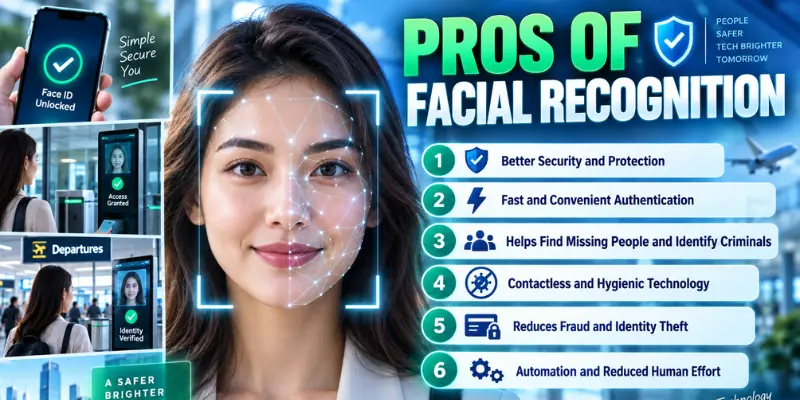
Facial recognition offers several benefits that can make identity verification faster, easier, and more convenient. Here are some of the main advantages of using this technology.
1. Better Security and Protection
One of the most prominent benefits associated with facial recognition is better security. It verifies a user’s identity and can prevent unauthorized access to restricted information or private areas. For example, facial recognition can be used for securing personal data on smartphones and restricting entry into the office space.
Also, unlike password protection, the user’s face cannot be copied and passed on to another person.
2. Fast and Convenient Authentication
Identification through facial recognition is a quick process. Users don’t have to memorize passwords, enter PIN codes, or carry access cards. For example, you can unlock your phone in a few seconds using your face. The same applies to airports and websites that use facial recognition to speed up identification.
This makes authentication faster and more convenient for users.
3. Helps Find Missing People and Identify Criminals
Facial recognition can help law enforcement identify people during investigations. It can be used to find missing people or compare images from security footage with existing records.
When used legally and responsibly, facial recognition technology may assist in maintaining law and order.
4. Contactless and Hygienic Technology
Facial recognition is not based on physical contact; unlike fingerprint scanning machines or other touch technology, users just need to look at the camera.
It can be used in environments where access needs to be provided to many individuals, including airports, hospitals, or other facilities that are open to the public.
Moreover, contactless technology can help reduce physical contact and may lower the risk of spreading germs.
5. Reduces Fraud and Identity Theft
Businesses and financial institutions may employ facial recognition technology to verify that an individual is actually who he/she claims to be.
For example, some websites use facial verification during account creation or while processing any significant transaction.
Such an additional security measure may make it more difficult for fraudsters to use stolen personal data for impersonation.
6. Automation and Reduced Human Effort
One more strength of facial recognition is its ability to automate tasks that had to be performed manually.
At many locations, there is a requirement for employees to check papers, tickets or IDs. With facial recognition, the whole procedure is much quicker and helps to minimize the workload of the staff.
For example, airports may use facial recognition to facilitate passenger verification, while firms may do the same for employee access control.
Cons of Facial Recognition Technology
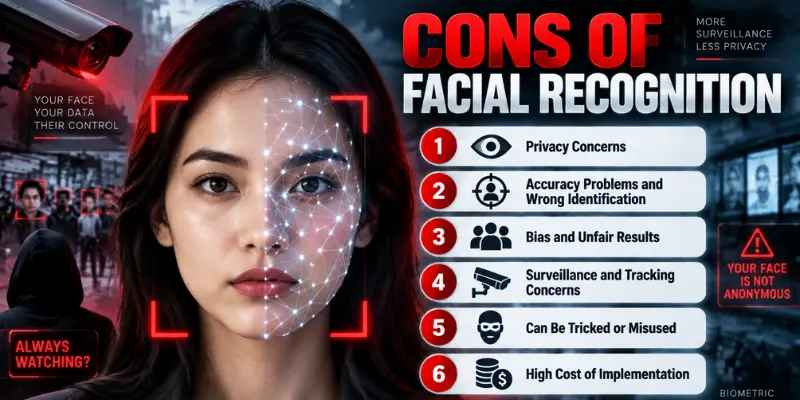
Although facial recognition provides many benefits, it also has some important disadvantages related to privacy, security, accuracy, and misuse.
Here are some of the main disadvantages of facial recognition.
1. Privacy Concerns
Privacy is one of the major issues when it comes to facial recognition.
A person’s face is something private, and unlike a password, it cannot simply be changed if someone gets access to their facial data. Stolen or misused facial data can be difficult to protect or replace.
There are concerns that organizations and government bodies may gather facial data without clear permission or use it in unexpected ways.
Cameras installed in public areas can also be used to track the movements of individuals without their knowledge.
2. Accuracy Problems and Wrong Identification
Facial recognition is not always perfect. Sometimes the system may fail to recognize the correct person or may incorrectly match someone with another individual.
Accuracy can be affected by:
- Poor lighting conditions
- Low-quality cameras
- Changes in appearance
- Different facial expressions
A wrong identification can create serious problems, especially when facial recognition is used for security or law enforcement purposes.
3. Bias and Unfair Results
Some facial recognition technologies may not work equally well for all groups of people.
When the technology is trained with data that does not properly represent different groups, it may be less accurate for some people. This can lead to unfair or discriminatory results, especially when facial recognition is used for security screening or criminal investigations.
To reduce this risk, the technology should be properly tested with diverse and representative data.
4. Surveillance and Tracking Concerns
It becomes easier to track people when there is facial recognition technology in place.
However, even though it can improve safety, it also poses challenges related to continuous surveillance. There is a fear that facial recognition technology may infringe upon people’s right to privacy because their actions could be monitored without their consent.
The challenge here is finding a balance between improved safety and personal rights.
5. Can Be Tricked or Misused
Although facial recognition systems are becoming more advanced, they are not completely impossible to fool.
Some systems may be affected by:
- High-quality photos
- Videos
- Fake images
- Masks or other tricks
Modern systems use additional security methods, such as checking for real human presence, but vulnerabilities can still exist.
6. High Cost of Implementation
Setting up a facial recognition system can be expensive.
Organizations may need to invest in:
- High-quality cameras
- AI software
- Data storage
- Security systems
- Regular maintenance
For small businesses or organizations with limited budgets, these costs can become a challenge.
Facial Recognition Uses in Different Industries
Facial recognition is used in many areas because it provides fast identity verification. However, each industry also faces different challenges.
1. Facial Recognition in Smartphones
Facial recognition technology has been implemented in many of the current smartphones for unlocking phones and securing personal information.
The advantage is convenience, as people can unlock their phones without passwords. In addition, it provides an extra layer of security for apps and payments.
People should be aware of how the phone manufacturer secures their facial information.
Facial Recognition in Airports and Travel
Airports use facial recognition technology to speed up passenger identification and enhance security.
The need to present a passport and boarding pass can sometimes be reduced, as passengers can identify themselves through facial recognition technology.
However, this creates concerns about the management of passenger data.
3. Facial Recognition in Healthcare
Facial recognition technology could be used in healthcare organizations to help identify patients and enhance record keeping.
For example, hospitals may make use of this technology to validate patient identities and minimize errors arising from inaccurate information.
Healthcare data is very sensitive, so protecting patient privacy is important.
4. Facial Recognition in Businesses
Facial recognition can be employed by firms for such purposes as building access, employee management, and customer assistance.
It can help firms improve security and automate some operations.
However, firms should develop clear policies explaining when and how customer and employee facial information is collected.
Is Facial Recognition Safe?
Facial recognition is not completely safe or completely dangerous. Its safety depends on how the technology is used and how carefully personal data is protected.
A responsible facial recognition system should include:
- Clear user permission
- Strong data security
- Accurate testing
- Transparent policies
- Proper legal guidelines
When used responsibly, facial recognition can provide useful benefits. When used without proper controls, it can create serious privacy and security risks.
Facial Recognition vs Traditional Passwords
Both facial recognition and traditional passwords have their own advantages and disadvantages.
| Facial Recognition | Traditional Passwords |
|---|---|
| Quick and convenient | Can take more time to enter |
| Uses your face for verification | Uses a secret password for verification |
| No need to remember a password | Requires you to remember a password |
| Cannot be easily changed if compromised | Can be changed if compromised |
| Requires biometric data protection | Requires password security |
| Can be affected by recognition errors | Can be affected by weak or stolen passwords |
Facial recognition offers greater convenience, while traditional passwords provide more flexibility and control. The better option depends on the user’s security, convenience, and privacy needs.
Conclusion
So guys, in this article, we’ve covered the pros and cons of facial recognition in detail. Facial recognition can make authentication faster and more comfortable, but it also comes with privacy, security, and accuracy concerns.
In my recommendation, you should use facial recognition when it comes from a trusted system and your facial data is properly protected. Before using it, always check how your data is collected and stored.
If you found this guide helpful, keep exploring Mobile Phone Guide for more simple and practical technology tips.
Frequently Asked Questions (FAQs)
Here are the answers to some common questions about the benefits and drawbacks of facial recognition :
The benefits include quicker identification of the individual, increased security, prevention of fraud, contactless entry, and helping police identify the person.
Some of the major drawbacks include issues with privacy, dangers of data theft, incorrect results, bias, surveillance, and abuse of private information.
Yes, facial recognition systems can face security risks if biometric databases are not properly protected.
It is controversial because it provides security benefits but also raises concerns about privacy, tracking, and how personal data is used.






- Be Respectful
- Stay Relevant
- Stay Positive
- True Feedback
- Encourage Discussion
- Avoid Spamming
- No Fake News
- Don't Copy-Paste
- No Personal Attacks
- Be Respectful
- Stay Relevant
- Stay Positive
- True Feedback
- Encourage Discussion
- Avoid Spamming
- No Fake News
- Don't Copy-Paste
- No Personal Attacks
