Advantages and Disadvantages of 5G You Should Know Before Upgrading
Published: 7 Sep 2026
5G is changing the way people connect to the internet, use smartphones, and interact with smart devices. It offers faster speeds, lower latency, and better support for a large number of connected devices.
These improvements make 5G useful for streaming, gaming, businesses, IoT, and smart technologies. However, it also comes with limitations such as uneven coverage, expensive infrastructure, battery concerns, and security risks.
Understanding the advantages and disadvantages of 5G helps users decide whether this technology is truly useful for their needs.
What Is 5G?
5G refers to the fifth generation of mobile network technology. It is the successor to 4G LTE and is designed to improve mobile internet performance in several ways.
The 5G network can offer higher speeds, lower latency, and greater capacity than traditional mobile networks. Simply put, it can carry larger amounts of data, has the ability to provide quicker response times and supports more numbers of connecting devices.
This is important because mobile networks now support much more than calls and text messages. Today, smartphones stream high-definition videos, transfer large files, run cloud applications, connect with smart devices, and support online gaming. Businesses also rely on mobile connectivity for security systems, logistics, machinery, and real-time tracking.
5G is designed to support these growing demands for mobile connectivity. However, its performance can vary depending on location and network conditions. While users in some cities may experience fast 5G speeds, those in rural areas may still rely mainly on 4G coverage.
Advantages and Disadvantages of 5G
Before looking at each point in detail, here’s a quick comparison of the key advantages and disadvantages of 5G.
| Advantages of 5G |
|---|
|
| Disadvantages of 5G |
|---|
|
Let’s now discuss these benefits and drawbacks in detail.
Advantages of 5G
The main benefits of 5G are connected to speed, network response, capacity, and support for modern technologies.
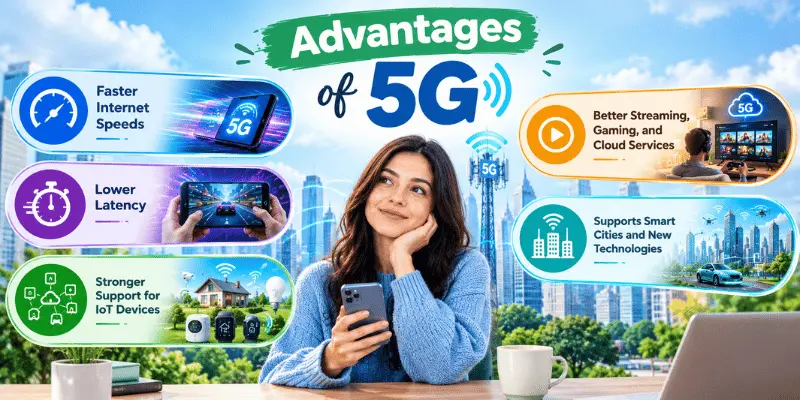
1. Faster Internet Speeds
Perhaps the first thing you notice after switching from 4G to a good 5G connection is speed.
Larger applications will load faster, video buffering will happen in a flash, and there could be higher streaming performance. Those individuals who work with videos, upload/download large work-related documents or use cloud services will definitely enjoy this additional speed.
For instance, a good 5G connection would allow downloading large games or updates significantly faster than using an ordinary mobile network. This would help business people who are used to working on their phones. Graphic designers, content producers, field specialists and telecommuters will have an opportunity to upload larger files when they are away from Wi-Fi.
However, the term “faster” does not imply uniformity in speed. Speed varies depending on the carrier, signal strength, network congestion, frequency band, and the device.
So, the advantage is real, but it is strongest when the network coverage is good.
2. Lower Latency
One of the key advantages of 5G is its lower latency, which means less delay between sending a request and receiving a response. This makes online activities feel faster and more responsive.
For example, lower latency can improve online gaming by reducing the delay between pressing a key and seeing the action on screen. It can also make video calls more responsive and support cloud gaming, remote control systems, industrial devices, and connected vehicles.
Lower latency is especially useful for applications that depend on real-time communication. While 5G cannot eliminate network delay completely, it can provide a quicker response than previous mobile network technologies.
3. Better Performance in Crowded Areas
Mobile networks often struggle in busy places such as stadiums, airports, shopping malls, concerts, and city centers, where thousands of people may be using their phones at the same time. Even when the signal bars look fine, the network can become overloaded.
5G is designed to handle a larger number of connected devices within the same area. This can improve the experience when many people are streaming, uploading, messaging, or using online services at once.
The benefit is not limited to smartphones. Cameras, traffic sensors, payment machines, smart signs, and other connected devices can also use the network. A network that can handle more connections without slowing down is increasingly important as cities become more connected.
4. Stronger Support for IoT Devices
The Internet of Things, or IoT, includes devices that connect to the internet and share data. Examples include smart security cameras, home sensors, industrial machines, smart meters, connected vehicles, and agricultural equipment.
With an increase in the number of such gadgets, there will arise a need to facilitate more connectivity without overwhelming the network.
Take the case of a smart factory where there may be machines that relay information about the temperature, movement, rate of production, or any machine condition. Agricultural sensors can monitor soil, water, or weather conditions.
5G can help provide a good network base for such systems.
It is not always easy to see the value of the 5G network to the average consumer, but this value can manifest itself in different scenarios.
5. Better Streaming, Gaming, and Cloud Services
Entertainment is another area where 5G can make a difference. Video streaming requires a reliable and fast internet connection. With a poor network connection, users may experience buffering, low-quality videos, or interruptions.
A good 5G connection can provide a better streaming experience, especially when watching high-quality videos.
Cloud gaming can also benefit from 5G. Instead of processing the game entirely on the phone, cloud gaming uses remote servers to handle the processing and streams the game back to the device. This requires a fast connection with low latency, which 5G is designed to provide.
6. Supports Smart Cities and New Technologies
5G can help smart cities connect different systems and exchange information quickly. For example, connected traffic systems can monitor road conditions and congestion, while smart lighting can adjust based on traffic and activity to reduce energy use. Connected transportation systems can also provide real-time updates about routes and arrival times.
5G can also support newer technologies such as augmented reality (AR), virtual reality (VR), robotics, autonomous systems, and industrial automation. These technologies often need fast and responsive communication to exchange data and perform tasks efficiently.
Disadvantages of 5G
5G offers clear benefits, but it also comes with practical limits. Some of these issues affect users directly, while others create challenges for mobile network providers.
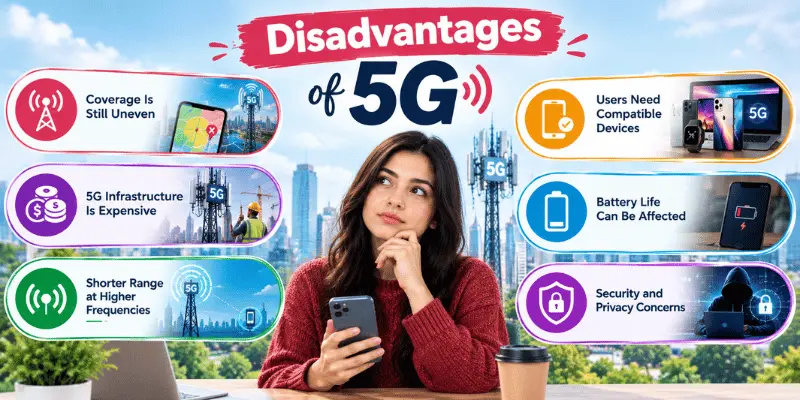
1. Coverage Is Still Uneven
One of the biggest disadvantages of 5G is that coverage is not the same everywhere. Larger cities are often among the first areas to receive wider 5G coverage, while small towns and rural areas may take longer.
Even within the same city, 5G performance can vary by location. Users may get a strong 5G connection outdoors but experience weaker performance indoors. In some areas, phones may also switch between 4G and 5G depending on signal availability.
For anyone considering a 5G phone, it is important to check the 5G coverage in their area before upgrading.
2. 5G Infrastructure Is Expensive
Building a 5G network requires a large amount of investment. Mobile operators may need new antennas, improved towers, fiber optics, small cells, and other equipment.
High-frequency 5G also requires more network sites because its signals have a shorter range. This makes widespread 5G implementation more difficult and expensive, particularly in rural and low-profit locations.
Businesses may also face high costs when setting up private 5G networks. They may need specialized hardware, network configuration, security measures, and technical support.
While users mainly notice the faster speeds of 5G, mobile operators need significant infrastructure and investment to build and maintain these networks.
3. Shorter Range at Higher Frequencies
Some types of 5G use high-frequency signals to provide very fast speeds. However, these signals generally have a shorter range and can be blocked or weakened by obstacles such as walls, trees, glass, and buildings.
As a result, a user may get a strong, high-speed 5G connection near an antenna but experience weaker performance inside a nearby building. To improve coverage, mobile network providers may need to install more small cells in busy areas.
This limitation does not apply to all 5G networks. Lower-frequency 5G can cover longer distances, but it generally offers lower speeds than higher-frequency bands.
4. Users Need Compatible Devices
A 4G-only phone cannot connect to a 5G network. Users need a smartphone with 5G-compatible hardware to access 5G services.
For people with older phones, switching to 5G may mean paying for a new device. Some network providers may also require a compatible mobile plan to access their 5G service.
This is especially important for users considering a new phone mainly for 5G support. If 4G already works well and 5G coverage is poor in their area, the extra cost of a 5G phone may not provide much benefit.
5. Battery Life Can Be Affected
5G can sometimes increase battery use, especially when the signal is weak. A phone may use extra power while searching for a 5G signal or switching between 4G and 5G networks.
However, this does not mean every 5G phone has poor battery life. Modern processors and modems are becoming more efficient at managing mobile connections.
Network conditions still matter. Constantly switching between strong and weak coverage can drain the battery faster. Heavy activities such as streaming, gaming, and large downloads can also use more power regardless of the network type.
For most users, battery impact depends on both the phone and the quality of 5G coverage.
6. Security and Privacy Concerns
As more devices become connected, the number of possible security risks also grows. 5G can connect smartphones, cameras, sensors, industrial devices, and cars. If any device isn’t secure enough, it can become an easy target.
Weak passwords, outdated software, insecure applications, and unprotected IoT devices might lead to security problems.
However, that doesn’t mean 5G is always vulnerable. The increased number of connected devices requires enhanced cybersecurity measures.
For ordinary users, this means keeping smartphones updated, using strong passwords and authentication, and avoiding suspicious applications or sites.
5G vs 4G: What’s the Difference?
The difference between 4G and 5G is not only about speed. 4G is already a mature technology with broad coverage in many countries. For basic browsing, messaging, social media, video streaming, and everyday apps, it still works well.
5G is designed for heavier network demand.
| Feature | 4G | 5G |
|---|---|---|
| Speed | Fast | Higher potential speed |
| Latency | Higher | Lower |
| Capacity | Good | Greater |
| Coverage | More established | Still expanding |
| Device Support | Very wide | Requires 5G hardware |
| IoT Support | Good | Designed for larger device networks |
Overall, 5G offers higher performance and greater capacity, but its coverage is still expanding and older phones cannot support it. In comparison, 4G is more widely available and continues to provide reliable connectivity for everyday mobile use.
Conclusion
So guys, in this article, we’ve covered the pros and cons of 5G in detail. While 5G can provide a faster and more responsive mobile experience, it also has some limitations, including uneven coverage, higher costs, battery concerns, and the need for compatible devices.
Personally, I recommend 5G for users who have good 5G coverage and need better performance from their mobile internet. For everyone else, reliable 4G may still be enough for now.
Before upgrading, check your 5G coverage and choose the option that best fits your needs.
Frequently Asked Questions (FAQs)
Here are the answers to some common questions about the benefits and drawbacks of 5G :
For basic activities such as messaging, browsing, social media, and regular video streaming, 4G may already be enough. 5G becomes more useful if you want faster downloads, smoother high-quality streaming, lower latency, or better performance in busy areas.
Yes. Most 5G phones can connect to 4G networks when 5G is unavailable. This allows you to continue using mobile data in areas where 5G coverage has not reached.
5G and Wi-Fi use different technologies and operate under different conditions, so one cannot simply be called safer than the other. For everyday users, security depends more on factors such as network configuration, encryption, device updates, and safe browsing practices.
5G is neither completely good nor bad. It offers benefits such as faster speeds, lower latency, and greater network capacity, but it also has limitations such as coverage gaps, device costs, and battery concerns. Whether it is useful depends on your needs and local coverage.
Common disadvantages can include a higher purchase price, possible battery drain in weak coverage areas, limited 5G availability, and the need for a compatible 5G network plan. If 4G already meets your needs, these factors may make upgrading less worthwhile.





- Be Respectful
- Stay Relevant
- Stay Positive
- True Feedback
- Encourage Discussion
- Avoid Spamming
- No Fake News
- Don't Copy-Paste
- No Personal Attacks
- Be Respectful
- Stay Relevant
- Stay Positive
- True Feedback
- Encourage Discussion
- Avoid Spamming
- No Fake News
- Don't Copy-Paste
- No Personal Attacks
