Snapdragon vs MediaTek: Which Mobile Processor Is Better?
Published: 11 Aug 2026
If you are planning to buy a new smartphone for gaming, daily use, photography, or multitasking and are confused between Snapdragon and MediaTek, don’t worry. Both chipsets are widely used in Android smartphones and offer strong performance, but each has its own advantages.
In this guide, we will compare Snapdragon vs MediaTek in detail to help you understand their key differences and decide which processor is the better choice for your needs. Let’s get started!
What Is Snapdragon?
Snapdragon is a family of mobile processors developed by Qualcomm.
A Snapdragon processor is a system-on-a-chip, also called an SoC. It combines several components needed to operate a smartphone.
These components may include:
- CPU for general processing
- Adreno GPU for gaming and graphics
- Hexagon for AI processing
- Spectra ISP for camera processing
- Modem for mobile connectivity
- Wi-Fi and Bluetooth for wireless connections
- Audio and security features
Qualcomm offers Snapdragon processors across different price ranges. The Snapdragon 8 series is mainly designed for flagship phones, while the 7 series targets higher-tier devices. The 6 and 4 series are generally used in mid-range and affordable smartphones.
What Is MediaTek?
MediaTek develops processors for smartphones, tablets, televisions, wireless devices, and other electronic products.
Its main smartphone processor families are:
- Dimensity: Mainly used in 5G smartphones
- Helio: Mainly used in selected 4G smartphones
The Dimensity family covers several performance levels. The 9000 series targets flagship phones, while the 8000, 7000, and 6000 families serve premium, mid-range, and affordable devices.
A MediaTek smartphone processor may include:
- Arm-based CPU cores
- Mali or Immortalis graphics
- MediaTek NPU or APU
- Imagiq camera processing
- Integrated mobile modem
- HyperEngine gaming features
- MiraVision display technology
- Video-processing hardware
10 Key Differences Between Snapdragon and MediaTek
While both Snapdragon and MediaTek offer powerful mobile chipsets, they differ in several important areas. The table below provides a quick comparison before we look at each point in detail.
| Feature | Snapdragon | MediaTek |
|---|---|---|
| Developer | Qualcomm | MediaTek |
| Main families | Snapdragon 8, 7, 6, and 4 | Dimensity and Helio |
| Flagship range | Snapdragon 8 series | Dimensity 9000 series |
| Graphics | Qualcomm Adreno | Arm Mali or Immortalis |
| Gaming technology | Snapdragon Elite Gaming | MediaTek HyperEngine |
| AI processing | Qualcomm Hexagon | MediaTek NPU or APU |
| Camera processing | Qualcomm Spectra ISP | MediaTek Imagiq |
| Display technology | Snapdragon display technologies | MediaTek MiraVision |
| Phone availability | Wide range of Android brands | Wide range, especially value-focused phones |
| Best suited for | Gaming, connectivity, and premium choices | Performance, efficiency, and value |
Now, let’s explore each difference in detail.
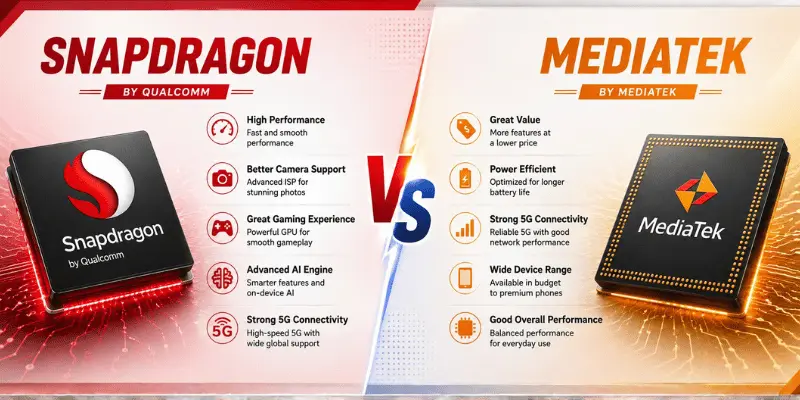
1. Manufacturer and Processor Families
Snapdragon processors are developed by Qualcomm, while Dimensity and Helio processors are developed by MediaTek.
Qualcomm offers Snapdragon processors across different performance tiers. The Snapdragon 8, 7, 6, and 4 series cover flagship, premium, mid-range, and affordable smartphones.
MediaTek uses the Dimensity brand mainly for 5G smartphones, while Helio processors are used in selected 4G devices. The Dimensity lineup also covers different performance levels, so the exact model and generation matter when comparing processors.
Both companies continue to bring advanced features from higher-end processors to more affordable chipsets. As a result, newer mid-range processors can offer features that were once mainly found in flagship devices.
2. CPU and General Performance
The CPU manages applications, system instructions, multitasking, background processes, and general phone performance.
Snapdragon processors use different CPU designs depending on the series and generation. Premium Snapdragon platforms may use Qualcomm’s custom Oryon CPU, while many other Snapdragon chips use Arm-based CPU designs.
MediaTek mainly uses Arm CPU cores. Some flagship Dimensity processors use an all-big-core design, which focuses on powerful cores for demanding workloads.
Both companies can deliver fast performance. The actual result depends on factors such as:
- Processor generation
- CPU architecture
- Clock speed
- Number and type of cores
- Phone cooling
- RAM and storage
- Software optimization
3. GPU and Gaming Performance
The Snapdragon chip is powered by the Qualcomm Adreno GPU. More advanced versions of Snapdragon chips can also offer Snapdragon Elite Gaming capabilities for graphics processing.
MediaTek processors commonly use Arm Mali or Immortalis GPUs. Its HyperEngine technology helps optimize gaming performance, connectivity, responsiveness, graphics, and power efficiency.
Snapdragon has traditionally been a popular choice for gaming because:
- Adreno graphics receive broad game support.
- Snapdragon appears in many gaming-focused phones.
- More gaming accessories and applications are tested on Snapdragon devices.
- Many Snapdragon phones include advanced cooling systems.
4. Heating and Sustained Performance
Both Snapdragon and MediaTek processors can generate heat during demanding tasks.
A phone may become warm while:
- Playing games
- Recording high-resolution video
- Using mobile data
- Running navigation
- Editing videos
- Fast charging
- Processing AI tasks
When a phone becomes too hot, it may reduce processor speed to control the temperature. This is known as thermal throttling.
Neither Snapdragon nor MediaTek is always cooler. Heat generation depends on several factors, including the chipset, cooling system, phone design, software optimization, workload, network conditions, and surrounding temperature.
Both companies also use technologies to balance performance, power consumption, and responsiveness during demanding tasks. However, the phone’s cooling system and overall design can have a major impact on sustained performance.
5. Battery Efficiency
Processor efficiency has an impact on battery life since it controls applications, connectivity, camera, games, and background operations.
Both Snapdragon and MediaTek use efficient CPU designs and power-management technologies to balance performance and battery consumption.
MediaTek ensures power efficiency in Dimensity processors by designing the CPU, controlling the workloads, integrating connectivity features, and game management with HyperEngine. Similarly, the Snapdragon series incorporates advancements in CPU, GPU, AI, Modem, and software to balance efficiency and performance.
However, processor efficiency is just one aspect of battery life. Other factors that affect battery life include:
- Battery capacity
- Display resolution
- Refresh rate
- Screen brightness
- Software optimization
- Network quality
- Background applications
- Camera and gaming use
A MediaTek phone can last longer than a Snapdragon phone, and vice versa. For a fair comparison, check battery tests of the exact phone models.
6. Camera and Video Processing
Both processor families include image signal processors that help convert camera data into photos and videos.
Snapdragon processors use Qualcomm Spectra ISP technology. Depending on the model, it can support HDR, autofocus, noise reduction, multiple cameras, high-resolution photography, and advanced video recording.
MediaTek uses Imagiq camera technology. Imagiq supports features such as HDR photography, video processing, noise reduction, face detection, high-resolution sensors, and AI-assisted image improvements.
Neither Snapdragon nor MediaTek guarantees better camera quality.
Final image quality also depends on:
- Camera sensor
- Lens quality
- Optical image stabilization
- Camera application
- Manufacturer processing
- Colour tuning
- Software updates
7. Artificial Intelligence
Snapdragon and MediaTek processors both include dedicated hardware for AI tasks.
Snapdragon processors commonly use Qualcomm Hexagon AI technology. It can support on-device photography, voice processing, translation, search, image editing, and other AI features.
MediaTek processors use their own NPU or APU technology. Modern Dimensity processors support AI photography, generative AI, voice features, display improvements, and other on-device tasks.
Mobile AI may be used for:
- Live translation
- Voice recognition
- Photo editing
- Object removal
- Camera scene detection
- Battery optimization
- Search features
- Personal assistants
8. Mobile Network and Connectivity
Snapdragon is widely known for Qualcomm modems and wireless technologies.
Depending on the processor model, a Snapdragon platform may support:
- 4G or 5G
- Wi-Fi
- Bluetooth
- GPS
- FastConnect
- Network power management
MediaTek Dimensity processors also include 5G modems and support modern Wi-Fi, Bluetooth, navigation, and dual-SIM features.
Snapdragon may have an advantage in some premium connectivity features because Qualcomm develops processors, modems, antennas, and related network technologies.
However, real network performance depends on more than the processor. It also depends on:
- Supported network bands
- Phone antenna design
- Mobile operator
- Country
- Signal strength
- Network traffic
- Software optimization
Before buying a phone, confirm that its exact regional model supports the 4G and 5G bands used by your mobile network.
9. Software, Applications, and Custom ROM Support
Snapdragon processors have historically had strong support across gaming, emulation, advanced applications, and Android development communities.
This is partly because Snapdragon chipsets are widely used in popular Android smartphones, including many premium and gaming-focused devices. Some users also prefer Snapdragon for:
- Emulation
- Custom ROMs
- Advanced camera applications
- Game optimization
- Developer tools
However, software and third-party support depend on the exact chipset and phone model. A popular MediaTek device may receive better third-party support than a less common Snapdragon phone.
10. Price and Overall Value
MediaTek processors are common in affordable and mid-range smartphones. Dimensity chips can offer 5G, good gaming performance, high-refresh-rate displays, AI features, and strong performance at competitive prices.
Snapdragon processors are available in affordable, mid-range, and flagship phones through the 4, 6, 7, and 8 series. Depending on the model, Snapdragon phones may offer advantages in gaming support, software compatibility, connectivity, and resale value.
The overall value of a phone depends on:
- Processor model
- RAM and storage
- Display quality
- Cameras
- Battery
- Charging speed
- Build quality
- Software updates
- Warranty
- Price
Don’t spend extra just for the Snapdragon name. Compare the various phone models and select the one with the best specifications and real-world performance for your budget.
Similarities Between Snapdragon and MediaTek
Snapdragon and MediaTek have several similarities:
- Both develop mobile system-on-a-chip platforms.
- Both offer processors for different price categories.
- Both support 4G and 5G phones.
- Both combine CPU, GPU, AI, camera, and modem components.
- Both support mobile gaming.
- Both provide advanced camera processing.
- Both support high-refresh-rate displays.
- Both focus on performance and battery efficiency.
- Both depend on phone cooling and software optimization.
- Both can provide strong or weak results depending on the phone.
Which One Should You Choose?
Let’s make it easier to choose between Snapdragon and MediaTek based on your needs:
Choose Snapdragon If:
- Serious gaming is your main priority.
- You want a gaming-focused phone.
- You prefer broad application support.
- You need advanced connectivity.
- You use emulators or custom software.
- The Snapdragon phone performs better in real tests.
Choose MediaTek If:
- You want strong performance at a reasonable price.
- You need an affordable or mid-range 5G phone.
- You mainly use normal applications and social media.
- The phone provides good battery life.
- You want better overall specifications within your budget.
- Real-world reviews show stable performance.
Tips and Mistakes to Avoid
Keep these tips in mind and avoid common mistakes when comparing Snapdragon and MediaTek processors.
Useful Tips
- Check the exact processor model.
- Compare chipsets from the same category.
- Review gaming, battery, heating, and camera tests separately.
- Check sustained performance instead of relying on one benchmark score.
- Confirm network band support.
- Consider software updates and phone cooling.
- Compare the complete smartphone, not just the processor.
Mistakes to Avoid
- Assuming every Snapdragon processor is faster.
- Believing MediaTek is only used in cheap phones.
- Comparing a flagship processor with an entry-level processor.
- Depending only on benchmark results.
- Ignoring phone cooling.
- Ignoring software optimization.
- Buying a phone only because of its processor brand.
Conclusion
So guys, in this article, we’ve covered the difference between Snapdragon and MediaTek in detail. Snapdragon may be suitable for users who prioritize gaming and software support, while MediaTek can be a great option for strong performance at a competitive price. My recommendation is to compare the exact chipsets and complete phone specifications before making a decision.
Take your time, compare the available options, and choose the smartphone that gives you the best value.
Frequently Asked Questions
Here are answers to some common questions about Snapdragon vs MediaTek processors:
Qualcomm manufactures Snapdragon processors. MediaTek manufactures Dimensity processors for 5G phones and Helio processors for certain 4G phones.
Snapdragon is usually considered a preferable choice when it comes to gaming, software compatibility, and connectivity. However, MediaTek might offer similar performance at a more reasonable price. It depends on specific processors and phones.
Not all the time. Heating up depends on the engine, the phone’s cooling system, the software, the amount of work being done, the strength of the network, and the temperature of the area.
Neither Snapdragon nor MediaTek always provides better battery life. Battery life depends on the chipset, battery capacity, display, software optimization, network usage, and how you use the phone. For a fair comparison, check battery tests of the exact smartphone models.
Yes, MediaTek processors can provide excellent gaming performance, especially its higher-end Dimensity chipsets. They support powerful GPUs, high-refresh-rate displays, and HyperEngine gaming features. However, actual gaming performance also depends on the phone’s cooling system, software optimization, and exact chipset.





- Be Respectful
- Stay Relevant
- Stay Positive
- True Feedback
- Encourage Discussion
- Avoid Spamming
- No Fake News
- Don't Copy-Paste
- No Personal Attacks
- Be Respectful
- Stay Relevant
- Stay Positive
- True Feedback
- Encourage Discussion
- Avoid Spamming
- No Fake News
- Don't Copy-Paste
- No Personal Attacks
