Advantages and Disadvantages of eSIM
Published: 19 Jun 2026
eSIM technology is becoming more common in smartphones, tablets, smartwatches, and other smart devices. It allows users to activate mobile plans digitally without using a physical SIM card.
While eSIM offers benefits like faster activation, easier network switching, and better support for travel and dual SIM use, it also has some drawbacks such as limited device support, carrier restrictions, and transfer issues.
In this guide, we will explain the key advantages and disadvantages of eSIM in detail so you can decide whether it is the right choice for you. So, let’s dive in
10 Advantages of eSIM
eSIM offers several benefits compared to traditional SIM cards. Here are 10 main advantages of eSIM :
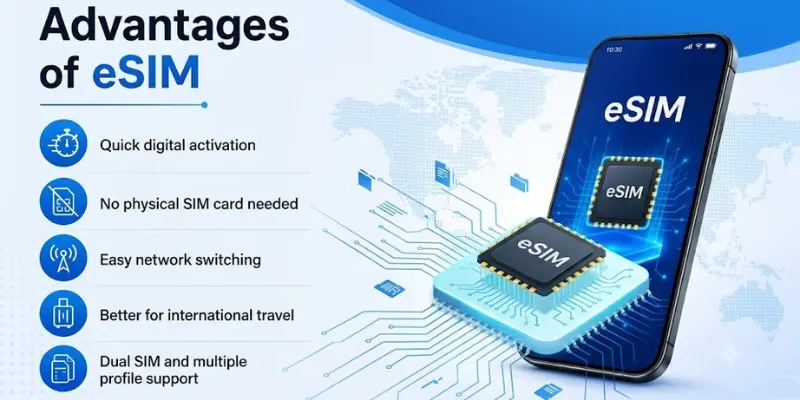
- Quick digital activation
- No physical SIM card needed
- Easy network switching
- Better for international travel
- Dual SIM and multiple profile support
- Improved security
- Space-saving device design
- Useful for smartwatches and IoT devices
- Eco-friendly technology
- Better flexibility for work and business
Now, let’s explore these advantages in detail.
1. Quick Digital Activation
One of the biggest advantages of eSIM is its quick activation process. You’ll not have to go to a store or wait for the SIM to arrive in the post. Most plans can be activated via carrier apps, phone settings or scanning a QR code.
Common benefits include:
- Faster mobile plan setup
- No need to wait for SIM delivery
- Easy activation through phone settings
This makes eSIM useful for people who want quick and simple mobile connectivity.
2. No Physical SIM Card Needed
eSIM eliminates the need to deal with swapping out a tiny plastic SIM card. The SIM function is already included in the device. This helps to eliminate risks of damaging, losing or misplacing your SIM card.
Really, it’s good information for those who frequently change the device or run multiple numbers. All activities take place digitally, making it cleaner and more modern.
Common benefits include:
- No SIM card loss
- No SIM tray handling
- Cleaner device setup
This is one reason many modern smartphones now support eSIM.
3. Easy Network Switching
Switching mobile plans is easier with eSIM than with traditional SIM cards. Users no longer need to swap physical SIM cards, as supported plans can be managed directly from the phone settings.
This can be useful for comparing networks, activating a temporary plan, or maintaining separate phone numbers for different purposes. For example, you can use one phone number for work and another for personal use, all on the same device.
Common benefits include:
- Easier plan switching
- Better number management
- Useful for temporary mobile plans
Overall, eSIM gives users more control over their mobile network choices.
4. Better for International Travel
eSIM is particularly convenient for travelers. A travel eSIM can be activated before or during your trip without purchasing a physical SIM card after arriving in another country.
This will save time and you won’t be going to the shops at the airport or your local market to find your SIM. There are many travel eSIM packages that can provide data for certain countries and regions.
Common benefits include:
- Easy travel data setup
- No need to find a local SIM shop
- Keep your main number active
For frequent travelers, an eSIM can make international connectivity much easier.
5. Dual SIM and Multiple Profile Support
Some eSIM-enabled phones allow users to use more than one mobile account. That is, you can store multiple numbers or plans in a single device.
It works for individuals who want a different number for their personal, professional or travel use. Depending on the phone model, it may be possible to have one physical SIM and one eSIM or two active eSIMs on the same phone.
Common benefits include:
- Work and personal number management
- Multiple plans on one phone
- Less need to carry two devices
This makes eSIM a flexible option for modern mobile users.
6. Improved Security
eSIM is harder to remove from a phone compared to a physical SIM card, which makes it more secure. In case your phone is lost or stolen, no one can take out the SIM and use it in another device.
However, eSIM security also depends on your phone lock, carrier account, and password protection. Because it is built into the device, it provides an extra layer of protection.
Common benefits include:
- Harder to remove from stolen phones
- Better protection against SIM theft
- Works with device security features
This makes eSIM a safer choice when used with proper security habits.
7. Space-Saving Device Design
Because eSIM is built into the device, manufacturers do not always need a physical SIM tray. This can save internal space and support cleaner phone designs.
The saved space may help improve device structure, water resistance, or internal component placement. This is one reason eSIM is useful for smaller and thinner devices.
Common benefits include:
- Less need for SIM tray space
- Cleaner device design
- Better use of internal space
This is a technical advantage that helps both users and device makers.
8. Useful for Smartwatches and IoT Devices
eSIM is not just for smartphones. It is also used in smartwatches, tablets, laptops, connected cars, and many Internet of Things (IoT) devices. These devices often have limited space, so including a physical SIM slot is not always possible.
For example, a smartwatch with eSIM can make calls and use mobile data even when your phone is not nearby.
Common benefits include:
- Works well in small devices
- Supports smart devices such as tablets, laptops, and IoT devices
This shows that eSIM is important for the future of smart technology.
9. Eco-Friendly Technology
eSIM can help reduce plastic waste because it removes the need for physical SIM cards and packaging. Traditional SIM cards often come with plastic cards, paper materials, and delivery packaging.
A single SIM card may look small, but millions are produced worldwide. Digital activation can reduce physical waste over time.
Common benefits include:
- Less plastic waste
- Less packaging material
- No SIM card shipping needed
This makes eSIM a more eco-friendly option compared to traditional SIM cards.
10. Better Flexibility for Work and Business
eSIM is very useful for business people, employees working remotely and companies. Businesses can start mobile plans for their employees without physical SIM cards.
Business and personal numbers can also be held on a single device for remote workers. It enhances communication and eliminates the idea of using several phones.
Common benefits include:
- Easy setup for employees
- Better work and personal separation
- Useful for business travel
In short, eSIM supports flexible work and modern business communication.
10 Disadvantages of eSIM
eSIM comes with some limitations that users should be aware of. It may not be suitable for every user, especially if the device or carrier does not fully support it.
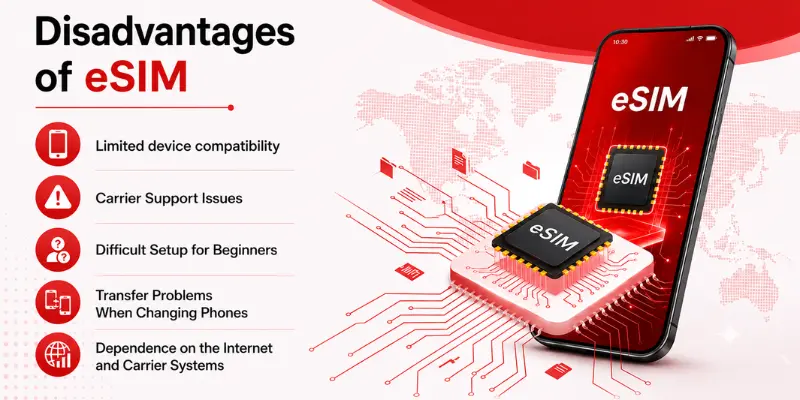
Here are the 10 main disadvantages of eSIM:
- Limited device compatibility
- Carrier Support Issues
- Difficult Setup for Beginners
- Transfer Problems When Changing Phones
- Dependence on the Internet and Carrier Systems
- Harder Troubleshooting
- Locked Phone Restrictions
- Privacy and Account Security Concerns
- Possible Cost Differences
- No physical SIM backup option
Now let’s take a closer look at these drawbacks.
1. Limited Device Compatibility
Not all phones support eSIM technology. Many older smartphones and some budget devices still rely only on physical SIM cards. Because of this, it is important to check whether your device is compatible before buying an eSIM plan.
eSIM support also varies by phone model and region. Some devices allow only one eSIM profile, while others support multiple profiles for different numbers or plans.
Common issues include:
- Older phones may not support eSIM
- Some budget devices lack eSIM functionality
- eSIM features may vary depending on the device and region
This is why device checking is important before switching to eSIM.
2. Carrier Support Issues
One major drawback of eSIM is limited carrier support. Not all mobile networks offer eSIM services, and some only provide them for selected plans, devices, or customers.
In some regions, eSIM support is still developing, which can create difficulties for users who want to switch networks or get proper activation support.
Common issues include:
- Some carriers do not offer eSIM
- Prepaid eSIM support may be limited
- Activation rules vary by carrier
This shows that eSIM depends heavily on your mobile service provider.
3. Difficult Setup for Beginners
For many users, eSIM setup is easy. But for beginners, it can feel confusing. A physical SIM is simple because you just insert it into the phone. eSIM may require a QR code, app, login, or carrier instructions.
If someone is not comfortable with mobile settings, the setup process may become stressful.
Common issues include:
- Confusing activation steps
- QR code scanning problems
- Carrier app errors
This is why physical SIM cards may feel easier for users who prefer a simple plug-and-play setup.
4. Transfer Problems When Changing Phones
Transferring a physical SIM to a new phone is very simple. You just remove it from one device and insert it into another. However, with eSIM, the process can be more complicated.
Users may need a new QR code or assistance from their carrier to complete the transfer. This can be inconvenient when upgrading to a new phone.
Common issues include:
- Transfer may need carrier approval
- The old QR code may not work again
- Setup can fail during phone change
This is one of the most common concerns about eSIM.
5. Dependence on Internet and Carrier Systems
eSIM activation usually depends on digital systems. You may need Wi-Fi, carrier servers, or a working app to complete the setup. If any of these fail, the activation process may be delayed.
This can be a problem when setting up a new phone or traveling in a place with weak internet.
Common issues include:
- Wi-Fi may be needed
- Carrier servers can fail
- Activation may take time
So, while eSIM is convenient, it still depends on reliable digital systems.
6. Harder Troubleshooting
eSIM issues can be more difficult to fix compared to physical SIM cards. A physical SIM can easily be removed, cleaned, or tested in another phone.
With eSIM, problems may be related to software settings, phone configuration, or carrier issues. Users may need to reset settings or contact customer support for help.
Common issues include:
- No physical SIM to remove for testing
- Network errors may be confusing
- Customer support may be required
This can make eSIM less convenient when technical issues occur.
7. Locked Phone Restrictions
If your phone is locked to one carrier, you may not be able to use another carrier’s eSIM. This is a common problem for people who buy phones on contracts or from specific networks.
This can also affect travelers who want to use international eSIM plans.
Common issues include:
- Other carrier eSIMs may not work
- Travel eSIMs may be blocked
- Unlocking may need carrier approval
That is why users should check whether their phone is unlocked before buying an eSIM.
8. Privacy and Account Security Concerns
While eSIM is generally secure, users should still protect their carrier accounts and login information. Since eSIM activation is handled digitally, scammers may try to obtain account details, verification codes, or login credentials through phishing attacks.
These risks are not unique to eSIM, but users should remain careful during the activation process.
Common issues include:
- Phishing attacks
- Weak account passwords
- Misuse of verification codes
Good password habits and two-factor authentication can reduce these risks.
9. Possible Cost Differences
Although eSIM does not require a physical SIM card, it is not always cheaper than a traditional SIM. Some travel eSIM plans may cost more than buying a local SIM card in the destination country.
The cost depends on factors such as the provider, country, data allowance, and plan duration. That is why it is important to compare prices before purchasing a plan.
Common issues include:
- Travel data may cost more
- Some plans have limited validity
- Prices vary by provider
So, eSIM is convenient, but not always the cheapest choice.
10. No Physical SIM Backup Option
Some newer devices are eSIM-only, meaning they do not include a physical SIM tray. This can be a problem if eSIM activation fails or if your carrier does not fully support eSIM services.
With a physical SIM, you can quickly insert another SIM card and restore connectivity. However, eSIM-only devices may require digital activation or carrier assistance before service can be restored.
Common issues include:
- No quick physical SIM replacement
- Setup failure can stop service
- Carrier help may be needed
This is why users should prepare before switching to an eSIM-only phone.
Conclusion
So guys, in this article, we’ve covered the advantages and disadvantages of eSIM in detail. While eSIM is a modern technology that simplifies mobile connectivity, it may not be the best option for everyone.
In my opinion, eSIM is a great choice for travelers, business users, and people who frequently manage multiple mobile plans. Before switching, make sure your device and carrier support eSIM properly.
If you found this guide helpful, share it with others and explore our related articles to learn more about mobile technology and smartphone features.
Frequently Asked Questions (FAQs)
Here are the answers to some common questions about the pros and cons of eSIM :
An eSIM is a digital SIM built into your phone. It lets you activate a mobile plan without using a physical SIM card. You can download it directly from your carrier.
Yes, many phones support dual SIM use. You can use one physical SIM and one eSIM at the same time. This is useful for work and personal numbers.
Yes, eSIM is generally secure. It is harder to remove from a stolen phone compared to a physical SIM. Still, you should protect your account with a strong password.
Yes, eSIM is very useful for travel. You can activate a travel plan before or during your trip. It helps you avoid buying a local SIM card.
No, eSIM is not available on all phones. It is mainly supported by newer smartphones and some high-end devices. Many older and budget phones still only use physical SIM cards. Always check your phone’s specifications before using an eSIM.



- Be Respectful
- Stay Relevant
- Stay Positive
- True Feedback
- Encourage Discussion
- Avoid Spamming
- No Fake News
- Don't Copy-Paste
- No Personal Attacks
- Be Respectful
- Stay Relevant
- Stay Positive
- True Feedback
- Encourage Discussion
- Avoid Spamming
- No Fake News
- Don't Copy-Paste
- No Personal Attacks
