Types of Mobile Processors Explained: Find the Best for You
Published: 16 Nov 2025
In the world of smartphones, the processor is the brain of your device. Whether you’re gaming, multitasking, or using apps, the mobile processor determines how smoothly everything runs. With so many options in the market, understanding the types of mobile processors can be confusing. But don’t worry, we’ve got everything you need to know.
In this guide, we’ll explore the major types of processors used in smartphones, their key features, and help you choose the best one for your needs. Let’s dive in and make the right choice together!
Major Types of Mobile Processors
There are various kinds of mobile processors, each designed for specific needs and performance levels. Here, we’ll explain the most popular ones and what makes them unique.
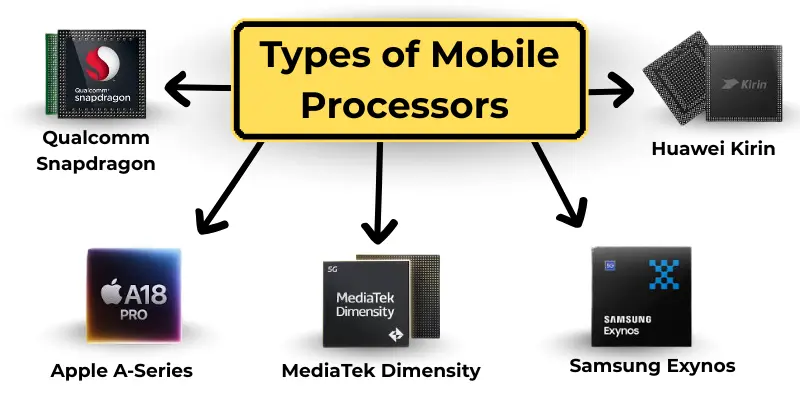
1. Qualcomm Snapdragon
Qualcomm Snapdragon processors are among the most popular and widely used mobile processors, especially in Android devices. Snapdragon processors offer a great balance between performance, efficiency, and connectivity.
The Snapdragon 8xx series powers high-end flagship phones, offering top-tier performance, fast 5G speeds, and AI capabilities.
On the other hand, the Snapdragon 4xx and 6xx series are used in mid-range and budget phones, providing solid performance for everyday tasks at an affordable price.
Why Choose Snapdragon?
- Great for gaming and multitasking.
- High performance with AI (Artificial Intelligence) and 5G (faster internet speeds) capabilities.
- Excellent power efficiency for longer battery life.
The Snapdragon 8 Gen 3 is currently the most powerful chipset, offering unmatched performance, cutting-edge AI, and lightning-fast 5G speeds, making it perfect for users who demand the best.
➡️ You may also Like this Post : Snapdragon vs MediaTek: Which Mobile Processor Is Better?
2. Apple A-Series
Apple’s A-Series processors are designed exclusively for iPhones and iPads. The A17 Bionic and A18 Bionic are prime examples of Apple’s innovation, offering incredible performance with energy-efficient designs.
These processors are deeply integrated into Apple’s ecosystem, resulting in optimized performance across apps, gaming, and battery life. Apple’s tight hardware-software integration gives iPhones and iPads an edge, especially in AI tasks and graphical rendering.
Why Choose Apple A-Series?
- Industry-leading single-core performance.
- Perfect for gaming and creative tasks.
- Efficient power management, especially in iOS devices.
The A18 Pro is Apple’s latest and most powerful processor, offering improved AI, better GPU performance, and faster 5G speeds. It’s the perfect choice for users seeking top-tier performance, whether for gaming, augmented reality, or creative tasks.
3. MediaTek Dimensity
MediaTek’s Dimensity series is known for delivering high-performance mobile processors that offer excellent value for money. It has gained significant popularity in the smartphone market due to its ability to balance power, efficiency, and affordability.
The Dimensity 1200 and Dimensity 9000 are examples of high-performance processors used in premium and flagship Android phones. The Dimensity series offers 5G connectivity, AI capabilities, and strong GPU performance for gaming.
Why Choose MediaTek Dimensity?
- Affordable yet powerful performance
- Great for 5G and gaming
- AI-enhanced features for better photo and video quality
The Dimensity 9200 is the latest processor in the series, offering even greater performance with advanced AI capabilities, improved 5G support, and a more efficient octa-core CPU architecture. It’s perfect for users looking for a powerful and budget-friendly processor that delivers flagship-level performance.
4. Samsung Exynos
Samsung develops its own processors, known as Exynos, which are mainly used in Samsung Galaxy smartphones. The Exynos processors compete with Snapdragon chips in terms of performance and 5G connectivity, although Snapdragon variants are often favoured in markets like the US.
Exynos processors are known for their energy efficiency and high GPU performance, making them suitable for tasks like gaming and streaming.
Why Choose Exynos?
- Excellent energy efficiency.
- Good performance in mid-range phones.
- Competitive GPU capabilities for gaming.
The Exynos 2500 is the latest and most powerful processor from Samsung, offering enhanced AI capabilities, faster 5G speeds, and improved GPU performance for superior gaming and multimedia experiences.
5. Huawei Kirin
The Kirin processors, developed by Huawei, are exclusive to their smartphones. The Kirin 990 and Kirin 9020 chips are powerful processors that support 5G, AI, and enhanced GPU performance. These chips are commonly seen in Huawei’s premium smartphones and are known for their performance in AI-based tasks like photo enhancement and smart features.
Why Choose Kirin?
- Optimised for AI tasks and photo enhancement
- High-end performance for flagship devices
- Excellent battery efficiency
The Kirin 9030 is the latest processor, offering a 20% boost in performance compared to the Kirin 9020. It is expected to launch in the Huawei Mate 80 series and provide better performance and efficiency, even though it uses the same 7nm process as the previous model.
6. Google Tensor
Google’s Tensor processors are custom-designed chips found in Google Pixel smartphones. They are built to deliver AI-focused performance, optimized for machine learning tasks, computational photography, and other Google-specific applications.
Their tight integration with Google’s software allows cutting-edge AI features such as real-time translation, enhanced photography, and better performance for voice assistants.
Why Choose Google Tensor?
- AI-centric features for enhanced photography and voice recognition.
- Integrated with Google’s software for smooth performance.
- Optimized for machine learning and on-device processing.
The Tensor G4 is the latest processor in the series, offering improved AI capabilities, better GPU performance, and faster 5G speeds.
7. Unisoc
Unisoc (formerly Spreadtrum) processors are typically used in budget-friendly smartphones. Although less powerful than Snapdragon or Apple’s A-Series, they provide good performance for basic smartphone tasks, including social media, browsing, and light gaming.
Unisoc is popular in emerging markets, offering affordable mobile devices with acceptable performance and power efficiency.
Why Choose Unisoc?
- Affordable and efficient for entry-level smartphones
- Good performance for basic tasks
- Perfect for budget-conscious users
The Unisoc T760 is the latest and most powerful processor, providing higher performance, better GPU capabilities, and improved efficiency. It’s the perfect choice for users seeking solid performance in gaming, AI tasks, and battery efficiency.
How to Choose the Right Processor for Your Smartphone
Choosing the right processor can be difficult, but understanding your needs and matching them to the processor features can simplify your decision. Here’s how to choose the best one based on key factors:
| Usage Type | Recommended Processor | Key Features |
|---|---|---|
| Gaming and Heavy Use | Snapdragon 8 Gen 3, Apple A18 Pro, Exynos 2500 | Top-tier performance, fast 5G, enhanced GPU capabilities |
| Everyday Use | Snapdragon 6xx series, Unisoc T760 | Good performance for basic tasks, affordable pricing |
| Battery Efficiency | Apple A-series, Snapdragon 7xx series | Energy efficiency for longer battery life, good performance |
| 5G and Connectivity | Snapdragon 8 Gen 3, Dimensity 9000, Exynos 2500 | Fast 5G connectivity, Smooth internet speeds |
| AI and Photography | Google Tensor, Kirin 9030 | AI-based features like photo enhancement, smart voice recognition |
| Budget Considerations | Unisoc T760, Snapdragon 4xx or 6xx series | Affordable, efficient for entry-level smartphones |
Conclusion
So guys, in this article, we’ve covered types of mobile processors in detail. From Snapdragon to Apple A-Series and Google Tensor, we’ve highlighted what makes each processor unique. Now that you know which processor suits your needs, make an informed decision when buying your next smartphone. Whether it’s for gaming or daily tasks, the right processor will elevate your experience.
Check out the latest models and choose the one that fits your needs!
Frequently Asked Questions (FAQs)
Here are the answers to some common questions about the different types of mobile processors :
The CPU in mobile devices is responsible for executing instructions and running applications. It handles all basic processing tasks such as calculating data, running apps, and performing system functions. Essentially, the CPU is the brain of the smartphone, ensuring smooth performance and multitasking.
A CPU (Central Processing Unit) is part of the mobile processor. The mobile processor, or System on Chip (SoC), includes the CPU along with other components like the GPU and AI unit. So, the processor is a more complete solution for a smartphone’s computing needs.
Currently, the Snapdragon 8 Gen 3 and Apple A18 Pro are some of the most powerful mobile processors. They offer top-tier performance with enhanced AI and 5G capabilities. These processors are used in high-end smartphones for gaming, multitasking, and other demanding tasks.
To choose the best processor, consider your usage needs. For gaming and high-performance tasks, look for high-end processors like Snapdragon 8 Gen 3. For everyday use, mid-range processors like the Snapdragon 6xx series work just fine.
AI in mobile processors helps your phone perform tasks smarter and faster. It enhances features like photo enhancement, real-time translation, and voice recognition. AI makes your phone more efficient by optimizing tasks without needing constant input.
Not necessarily. While premium processors like the Apple A18 Pro or Snapdragon 8 Gen 3 provide high performance, a more affordable processor like the Unisoc T760 can still offer excellent value. It all depends on how you use your phone and how much performance you require.
Snapdragon processors, made by Qualcomm, are known for their strong performance and wide availability in many smartphones. Exynos processors, made by Samsung, are mostly used in Samsung Galaxy devices, offering good performance, especially in gaming. The key difference is that Snapdragon is more common worldwide, while Exynos is often used in specific regions like Europe and Asia.






- Be Respectful
- Stay Relevant
- Stay Positive
- True Feedback
- Encourage Discussion
- Avoid Spamming
- No Fake News
- Don't Copy-Paste
- No Personal Attacks
- Be Respectful
- Stay Relevant
- Stay Positive
- True Feedback
- Encourage Discussion
- Avoid Spamming
- No Fake News
- Don't Copy-Paste
- No Personal Attacks
