Phone Charger Wattage Guide: Speed, Safety & Myths Explained
Published: 1 May 2026
When it comes to phone chargers, understanding wattage is important for choosing the right one. Typically, the power output of a charger ranges from 5W to 20W for standard models. However, with the rise of fast-charging technology, you’ll now find chargers that range from 30W to 100W and beyond. So, how many watts does a phone charger actually need for optimal performance?
In this article, we’ll explain what watts mean for your charger, how different charging technologies work, and help you choose the best one for your device. Let’s dive in.
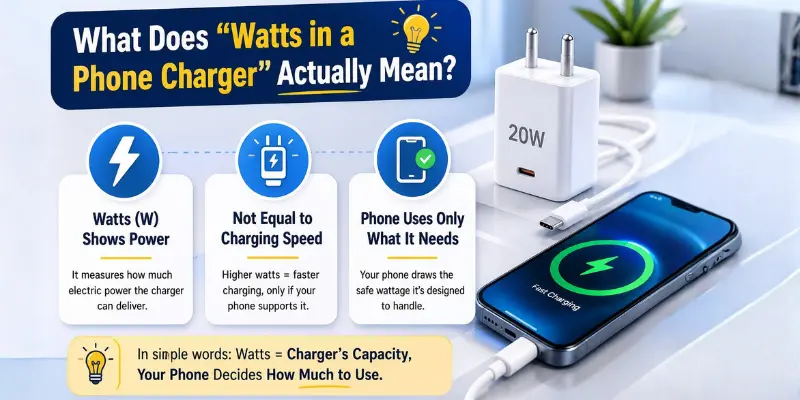
What Does “Watts in a Phone Charger” Actually Mean?
Wattage in a phone charger refers to the amount of electrical power it can deliver to your device. It’s calculated by multiplying the voltage (V) and amperage (A):
Watt = Voltage × Amperage.
Here’s how it works:
- Voltage (V) is the pressure that pushes electricity through the charging cable.
- Amperage (A) is the flow of electrical current.
When combined, this gives the charger its power (wattage). But a higher wattage doesn’t necessarily mean the charger is forcing more power into your phone. Instead, it indicates the charger’s capacity to deliver power.
Generally, a higher wattage allows for faster charging, but your phone must also be capable of handling that level of power to charge more quickly.
How Many Watts Does a Phone Charger Use?
Phone chargers use different wattage levels depending on the device and charging speed. Below are the most common charger wattages used today:
1. Standard Charging:
5W chargers are commonly found with older phones and are mainly used for slow, overnight charging. They deliver a constant, low rate of power to your phone while charging . While this is slower, it’s ideal for those who can leave their phone plugged in overnight.
2. Modern Charging:
10W-20W chargers are widely used for many smartphones, particularly mid-tier models. These chargers provide a balanced approach to charging and efficiency, as they offer a moderate charging speed that will charge your phone in a reasonable time while avoiding excessive stress on the battery. This is the type of charger that comes with most smartphones, including Samsung and Android devices.
3. Fast Charging:
18W–30W chargers are commonly used for fast charging on modern iPhones, Android phones, and other devices.
They deliver more power than standard chargers, helping your phone charge much faster — often reaching a high battery percentage in about an hour or less.
4. Super Fast Charging:
45W–65W chargers are commonly used with high-end Android devices, especially flagship models like Samsung Galaxy phones. They provide super-fast charging, allowing large batteries to charge in around an hour or less, depending on the device.
100W+ chargers are mainly used for laptops, tablets, and other devices with larger batteries that require more power to charge quickly. However, some modern smartphones also support 100W chargers, which can be used to charge their larger batteries rapidly, making them suitable for devices with higher power demands.
Can a Higher Watt Charger Damage Your Phone?
You may have heard that plugging your phone into a higher-watt charger will damage it. However, a higher-watt charger will not overpower your phone. Here’s why:
- Power Management: Your phone is equipped with a power control chip that only allows it to draw a certain amount of power. This chip manages to prevent the phone from using its charging power, even if the charger has a higher wattage.
So, even if you connect your phone to a 65W or 100W charger, it will only consume the 20W it needs.
Why Do Phones Only Take Limited Watts?
Every phone is designed to handle a specific amount of power based on its charging capabilities and internal components. The charging circuit and components, including the battery, thermal management system, and charging IC (Intelligent Chip), are built to support only specific wattages. For example, if your phone supports 20W charging, it will only draw up to 20W even when connected to a 65W or 100W charger.
Here’s how each component works:
- Battery Protection System: The phone’s battery has a built-in protection system to prevent damage from overcharging. Using too much power can heat up the battery and shorten its lifespan.
This system makes sure the battery only accepts as much power as it can safely handle at any given moment. - Thermal Control System: Heat is a byproduct of charging, especially with higher wattages. Phones have thermal control systems in place to keep the temperature within safe limits. If the temperature rises too much, the phone will reduce the charging speed to prevent overheating, which could damage both the battery and internal components.
- Charging IC (Intelligent Chip): The charging IC or intelligent chip is the “brain” of the charging process. It monitors the power flow and adjusts the voltage and amperage according to the phone’s needs.
This smart power management ensures your phone charges as quickly as possible without damaging the internal components.
How Many Watts Should You Choose for Your Phone?
When choosing the best charger wattage for your phone, it’s important to consider your device’s capabilities and how fast you want to charge. Here are some practical tips based on your phone’s model and your charging needs:
1. iPhone Users (20W–30W)
If you own an iPhone, a 20W to 30W charger is ideal. Recent models, including the iPhone 13, 14, and the latest iPhone 17, support fast charging. A 20W charger can give you about 50% charge in 30 minutes. While Apple’s 20W charger is sufficient, opting for a 30W charger can give you slightly faster charging speeds.
2. Android Users (25W–45W)
For Android users, particularly those with Samsung Galaxy and other common Android devices, a 25W-45W charger is ideal. Major flagship phones have 25W fast charging, and some even support 45W fast charging for faster recharges.
If you have a bigger battery, such as Samsung’s Galaxy S series, the 45W charger is ideal to get your phone fully charged in 1 hour.
Make sure you use the right charger for your device’s fast-charging capability.
3. Power Users (65W+ Multi-Device Charger)
If you use multiple devices like a phone, tablet, or laptop, a 65W or higher multi-device charger is a better option. These chargers deliver high power and can charge more than one device at the same time.
A 65W+ charger can quickly charge your phone while also powering devices like a laptop or tablet. This makes it a practical choice for users who want fast and efficient charging for all their devices together.
Conclusion
Now you clearly understand how phone charger wattage actually works and why it matters. A charger’s wattage (like 5W, 20W, 45W, or 65W) shows how much power it can deliver, but your phone only takes the amount it is designed for.
This means you don’t need to worry about using a higher-watt charger. Your phone will automatically control the power, keeping charging safe and stable. What really matters is using a charger that matches your device’s fast charging support so you get the best speed without harming the battery.
In short, choose a charger based on your phone’s capability, not just the highest watt number. The right charger gives you fast, safe, and efficient charging every day.
Frequently Asked Questions (FAQs)
Here are the answers to some common questions about how many watts is a phone charger:
You can use a 40W charger to charge your phone if your phone supports it. But your phone will only consume as much power as it can, so if it’s only capable of 20W charging, it will charge at that rate instead of 40W. Your phone won’t be damaged by the charger, due to smart power negotiation.
Using a 100W charger with an iPhone is safe, but it won’t charge your iPhone any faster than it’s capable of. The fast charging capabilities of iPhones are 20W to 30W, so the iPhone will only take the necessary power from the charger.
It’s best to use an Apple-branded charger for optimal performance and safety.
Not always. A higher-watt charger means it has the capacity to deliver more power, but your phone will only use the amount it is designed to handle.
Fast charging depends on both the charger and the phone’s supported charging technology. If your phone only supports 20W, it won’t charge faster even with a 65W charger. So, faster charging only happens when your device and charger both support the same fast-charging standard.
The average charger has a wattage of 5W to 20W. The old or cheap ones might be 5W, while newer phones use 10W-20W. For fast charging phones, the wattage of the charger is between 18W and 45W, and some high-end phones may use higher wattages for super-fast charging.






- Be Respectful
- Stay Relevant
- Stay Positive
- True Feedback
- Encourage Discussion
- Avoid Spamming
- No Fake News
- Don't Copy-Paste
- No Personal Attacks
- Be Respectful
- Stay Relevant
- Stay Positive
- True Feedback
- Encourage Discussion
- Avoid Spamming
- No Fake News
- Don't Copy-Paste
- No Personal Attacks
