Types of Power Banks Explained: Which Portable Charger Is Best for You?
Published: 4 Apr 2026
In the modern world of mobile phone technology, staying powered is essential. A reliable power bank (portable charger) can be a real lifesaver when your phone, tablet, or laptop runs out of battery at the worst moment.
Power banks come in many types and sizes, from small chargers that fit in your pocket to large ones for laptops and use outside.
This blog post will help you understand the different types of power banks and help you to choose the right one based on your needs, and avoid common mistakes.
Types of Power Banks
Power banks come in different types, each made for specific charging needs. The right choice depends on your devices, lifestyle, and how you use gadgets daily. They are portable, reliable, and designed to keep your devices powered wherever you go. Let’s take a look at the main types of power banks:
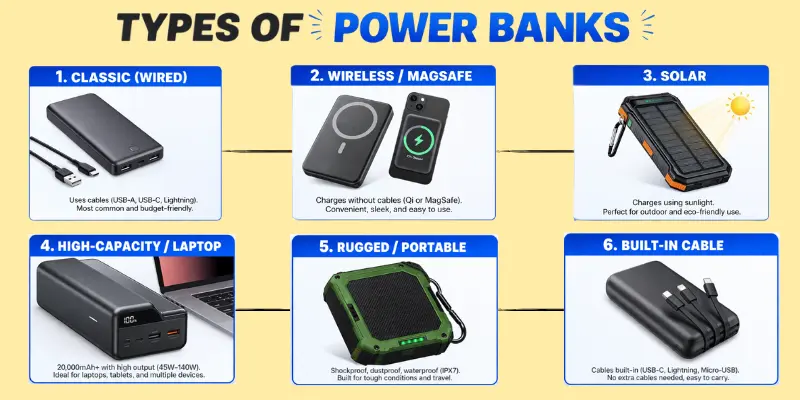
1. Classic / Wired Power Banks
These types of power banks use USB-C, USB-A, or Lightning cables for charging. They are the most common type and work with phones, tablets, and gadgets. Compact and affordable, they are ideal for daily use.
| Pros: |
|---|
|
| Cons: |
|---|
|
Best For:
- Users who don’t mind carrying a cable
- Daily phone or tablet charging
2. Wireless / MagSafe Power Banks
These power banks charge your devices without any cables using wireless charging (Qi) or MagSafe (for iPhones). Simply place or attach your device on the power bank, and it starts charging. They are convenient, lightweight, and perfect for quick top-ups on the go.
| Pros: |
|---|
|
| Cons: |
|---|
|
Best For:
- Office workers or travelers seeking convenient charging
3. Solar Power Banks
Solar power banks stand out for their integrated solar panels, enabling users to generate energy directly from sunlight. This feature makes them especially suited for eco-friendly use during outdoor activities, where regular power sources are unavailable.
| Pros: |
|---|
|
| Cons: |
|---|
|
Best For:
- Hikers, campers, or anyone spending time outdoors without power outlets
4. High-Capacity / Laptop Power Banks
High-capacity banks (20,000mAh+) with outputs of 45W–140W can charge laptops, tablets, and multiple devices. They are powerful, versatile, and essential for people who rely on heavy electronics while traveling.
| Pros: |
|---|
|
| Cons: |
|---|
|
Best For:
- Remote workers
- Students or professionals using laptops while traveling
5. Rugged / Portable Power Banks
Rugged power banks are shockproof, dustproof, and waterproof (IPX7), built to handle tough conditions. They are strong, durable, and perfect for outdoor adventures or harsh environments.
| Pros: |
|---|
|
| Cons: |
|---|
|
Best For:
- Camping trips
- Hiking
- Emergency kits
6. Built-in Cable Power Banks
Built-in cable power banks come with integrated cables like USB-C, Lightning, or Micro-USB, so you don’t need to carry extra cables. They are convenient, compact, and perfect for users who want a ready-to-use charger.
| Pros: |
|---|
|
| Cons: |
|---|
|
Best For:
- Travelers
- Users who want a simple, ready-to-use charging solution
How to Choose the Right Power Bank
Choosing the right power bank is more than just picking the biggest battery. Consider how much power it holds, how fast it charges, the kind of battery it uses, its size, and whether it works with your devices.
1. Capacity (mAh)
- Small (5,000–10,000): Provides one phone charge and is pocket-friendly.
- Medium (10,000–20,000): Offers 1–2 charges for phones or tablets and is suitable for travel.
- Large (20,000+): Charges laptops and multiple devices for long trips.
2. Charging Speed & Technology
- PD (Power Delivery): A fast charging feature that can quickly charge laptops, tablets, and smartphones. It is best for high-power devices.
- QC (Quick Charge): A fast charging technology mainly used for smartphones. It charges your phone faster than normal chargers.
- Pass-Through Charging: This feature allows you to charge your device while the power bank itself is also charging at the same time.
3. Battery Type
- Li-Po (Lithium Polymer): Lightweight and safer to use. It lasts longer (around 1,000 charge cycles) and is commonly used in slim and modern power banks.
- Li-ion (Lithium-ion): More powerful and usually more affordable. It lasts around 500–800 charge cycles but needs careful handling for safety.
4. Size & Portability
- Small: Easy to carry, but offers lower capacity.
- Large: Weightier to carry, but needed for laptops or multi-device charging.
5. Device Compatibility
- Phones: Most power banks work with smartphones, but make sure it supports fast charging for better speed.
- Tablets: Usually need at least 18W output for efficient charging.
- Laptops: Require high power (45W–140W) with Power Delivery (PD) support.
- Wireless vs Wired: Wireless charging is convenient but slower, while wired charging is faster and more reliable.
- MagSafe: Required for compatible iPhones that support magnetic wireless charging.
Common Mistakes to Avoid While Buying Power Banks
Even the best power bank won’t help if you pick it carelessly without knowing your needs. Many users make simple mistakes that reduce charging efficiency, safety, and convenience.
Here’s what to watch for while buying any type of power bank:
1. Ignoring Device Compatibility
Power banks don’t fit with every device. Laptops demand high-wattage PD support. Small 10,000mAh banks only serve phones or tablets.
- Tip: Always check output voltage, fast-charging support (PD/QC), and connector type.
2. Choosing Too Large a Capacity for Daily Use
High-capacity banks (20,000–27,000mAh) are great for travel but heavy for daily use.
- Tip: Always choose a capacity that matches your daily needs.
3. Ignoring Charging Speed & Cable Type
Fast charging features like PD (Power Delivery) or QC (Quick Charge) can save a lot of time. But if you use the wrong cable, your device may charge slowly or not work properly.
- Tip: Always use the correct cable type (USB-C, Lightning, or Micro-USB) that matches your device for the best charging speed.
4. Overlooking Durability & Water Resistance
Many people buy regular power banks and use them outdoors, which can lead to damage. Normal models aren’t built for rough conditions, water, or dust.
- Tip: Look for a rugged, shockproof power bank with an IPX7 waterproof rating for safe outdoor use.
Conclusion
So guys, in this article, we’ve covered types of power banks in detail. From wired and wireless options to solar and high-capacity models, each type is designed for different needs and usage.
My personal recommendation is to choose a power bank based on your daily usage instead of just going for the biggest capacity. A compact option works great for everyday use, while a high-capacity one is better for travel or laptops.
👉 Now it’s your turn — explore your options, pick the right power bank for your needs, and stay powered wherever you go
Frequently Asked Questions (FAQs)
When it comes to power banks, people often have many questions about types, capacity, charging speed, and brands. Here are the most common questions answered clearly to solve the problems of tech users.
Power banks mostly come in six main types:
- Classic (wired) power banks
- Wireless / MagSafe power banks
- Solar power banks
- High-capacity (laptop) power banks
- Rugged (durable) power banks
- Built-in cable power banks
Each type is designed for different needs, like daily phone charging, travel, outdoor use, or laptops.
It depends on your use. 10,000mAh is enough for daily phone top-ups. 20,000mAh is better for travel or charging multiple devices.
Choose a high-capacity power bank with PD (Power Delivery) support. Make sure it delivers at least 45W–140W, depending on your laptop.
Yes, if you charge laptops or multiple devices on the go. High-capacity banks are heavier but provide more charges and backup for long trips or emergencies.
Pick a lightweight, small-capacity bank (5,000–10,000mAh) for daily use. Check fast charging support, cable type, and device compatibility.
Both are reliable brands. Anker is known for high performance and fast charging. Belkin offers good build quality and portability. Choose based on your device and budget.




- Be Respectful
- Stay Relevant
- Stay Positive
- True Feedback
- Encourage Discussion
- Avoid Spamming
- No Fake News
- Don't Copy-Paste
- No Personal Attacks
- Be Respectful
- Stay Relevant
- Stay Positive
- True Feedback
- Encourage Discussion
- Avoid Spamming
- No Fake News
- Don't Copy-Paste
- No Personal Attacks
