What Is a Phone IP Rating? Dust & Water Protection Guide
Published: 12 Mar 2026
Smartphones are expensive, and even a small amount of water or dust can damage them. This is why many modern devices come with something called an IP rating. But what is a phone IP rating, and how can it help protect your device from everyday accidents?
In this blog post, you’ll learn everything you need to know about phone IP ratings, how they work, and which IP rating is best when buying a new smartphone.
What Does IP Stand for in Smartphones?
IP stands for Ingress Protection. Think of it as a safety badge showing how well your device can resist dust and water. This handy system was created by the International Electrotechnical Commission (IEC). You’ll find it on all sorts of gadgets, like smartphones, tablets, and smartwatches.
The IP rating measures how strong a device’s sealing is. If the seal is good, dust and water won’t sneak inside, so your phone’s precious insides stay safe.
In simple terms, an IP rating is like a durability score. It tells you how tough and protected your phone is in everyday life.
Here’s an example: If you accidentally drop your phone near water or often find yourself in dusty places, a higher IP rating means your phone has a better chance of staying safe. Peace of mind is always nice!
Why IP Ratings Are Important for Smartphones
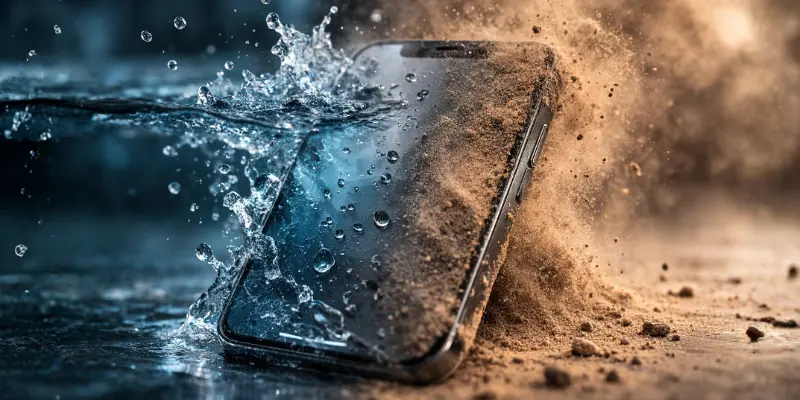
Smartphones go everywhere such as to the beach, in the rain, during workouts, or near pools. Without the right protection, even a little dust or water can damage the inside of your phone.
This is why IP ratings matter. They help you know how tough your phone is and how well it can deal with everyday casualties.
| Benefits of IP-Rated Phones |
|---|
|
How Phone IP Ratings Work
Phone IP ratings use two numbers to show how well a device resists dust and water.
Each number has a different meaning:
- First number → Dust protection
- Second number → Water resistance
In simple words, the first digit tells how well the phone blocks dust, while the second digit shows how resistant the phone is to water.
The First Digit: Dust Protection (0–6)
The first digit in an IP rating shows how well a phone can block dust and solid particles, like sand or dirt. This number ranges from 0 to 6, and a higher number means better dust protection.
Here is the basic scale:
| Rating | Dust Protection Level |
|---|---|
| 0 | No protection |
| 1 | Protected from large objects |
| 2 | Protected from fingers |
| 3 | Protected from small tools |
| 4 | Protected from small wires |
| 5 | Limited dust protection |
| 6 | Completely dust-tight |
The Second Digit: Water Protection (0–9)
The second digit in an IP rating shows how well a phone resists water. This number goes from 0 to 9, and a higher number means stronger water protection.
Here’s the general scale:
| Rating | Water Protection |
|---|---|
| 0 | No protection |
| 1 | Dripping water |
| 2 | Dripping water at an angle |
| 3 | Spraying water |
| 4 | Splashing water |
| 5 | Water jets |
| 6 | Powerful water jets |
| 7 | Immersion up to 1 meter |
| 8 | Continuous immersion deeper than 1 meter |
| 9 | High-pressure hot water jets |
Most Common Phone IP Ratings
Many modern smartphones come with IP ratings that show their resistance to dust and water. While several ratings exist, the most common ones you’ll see on devices are IP67 and IP68. Let’s look at what each rating offers and which phones have them.
IP67 Rating
A phone with IP67 provides strong dust and water protection.
Key Features:
- Fully dustproof – Keeps dust completely out.
- Water-resistant up to 1 meter – Endures brief submersion.
- Duration: Around 30 minutes.
This means your phone can withstand drops in sinks, puddles, or rain.
Example Phones with IP67:
- iPhone SE (3rd generation)
- Samsung Galaxy A56
These phones are great for everyday use, where splashes or brief water contact may happen.
IP68 Rating
IP68 is one of the highest protection ratings in smartphones.
Key Features:
- Fully dustproof – No dust enters the device.
- Water resistance deeper than 1 meter – Often around 1.5 meters.
- Duration: Usually 30 minutes or more.
As a result, IP68 phones can handle more serious water accidents than IP67 phones, such as drops in a pool or bathtub.
Example Phones with IP68:
- iPhone 17
- Samsung Galaxy S24
- Google Pixel 9
This is why many flagship phones use IP68, as users expect strong durability.
IP67 vs IP68: What’s the Difference?
Many people see IP67 and IP68 in phone specs and feel confused. Both ratings give strong protection, but they are not exactly the same.
Both IP67 and IP68 mean the phone is dust-tight. Dust cannot enter the device. The main difference is how much water the phone can handle.
Here is a simple comparison:
| Feature | IP67 | IP68 |
|---|---|---|
| Dust Protection | Dust tight | Dust tight |
| Water Depth | Up to 1 meter | 1.5 meters or more |
| Duration | 30 minutes | 30 minutes |
| Protection Level | Good | Better |
In simple terms, IP68 provides better water resistance than IP67. It allows the phone to survive in deeper water under test conditions.
Are IP-Rated Phones Really Waterproof?
Many people think an IP-rated phone is fully waterproof. This is a common myth. In reality, most smartphones are water-resistant, not waterproof.
Manufacturers test IP ratings in controlled lab conditions, a process called manufacturer testing. During the test:
- The phone is placed in clean freshwater for a short time.
- The device is brand new, with all stamps intact.
What Is a Good IP Rating for a Phone?
When buying a smartphone, it’s best to choose a device with at least IP67 or IP68. These ratings give reliable dust and water protection.
Quick Guideline
| Protection Level | IP Rating | Features |
|---|---|---|
| Good protection | IP67 | Safe from dust; survives short water immersion |
| Best protection | IP68 | Fully dustproof; strong water resistance |
Phones With the Best IP Ratings
Many smartphones with premium features today have IP68 approval, which means they are protected against dust getting inside and can withstand being submerged in water up to a certain depth for a limited time.
Example Phones by Brand
Apple
- iPhone 17
- iPhone 17 Pro
- iPhone 16 series
Samsung
- Samsung Galaxy S26
- Samsung Galaxy S25
- Samsung Galaxy Note series
- Google Pixel 9
- Google Pixel 8
These phones are made to handle normal drops, splashes, rain, or short dips in water, and they keep dust out.
Conclusion
In this article, we learned what a phone IP rating is and why it is important for smartphone safety. We also highlighted how the two digits in a phone’s IP rating indicate dust and water resistance.
The first number indicates the amount of dust protection, while the second represents water resistance. We also examined IP67 and IP68 and discovered why IP68 provides better protection.
I think you should always look at the phone’s IP rating before you buy a new smartphone. It helps you pick a phone that can handle everyday things like drops, rain, and small slips.
Frequently Asked Questions (FAQs)
Here are the answers to some common questions about phone IP rating:
The highest IP rating commonly found in smartphones is IP68.
This rating means the phone is fully dustproof and can stay in water deeper than 1 meter for a limited time. Some lab tests even go up to IP69 for industrial devices, but consumer phones rarely exceed IP68.
IP67 phones are not waterproof, but they are water-resistant.
They can withstand brief immersion in water up to one meter for around 30 minutes, but they are not intended for swimming or long-term underwater use.
The IP68 rating means that the phone is entirely dust-tight and water resistant. Most IP68 phones can survive water immersion up to 1.5 meters for 30 minutes, making them safer for splashes and accidental drops in water.
IP stands for Ingress Protection. It is a rating system that shows how well a device resists dust and water. The first number represents dust protection, and the second number represents water resistance.
In fact, IP68 phones can handle short submersion, but they are not designed for long periods of underwater use or swimming. Chlorine, saltwater, or strong currents can damage covers over time.




- Be Respectful
- Stay Relevant
- Stay Positive
- True Feedback
- Encourage Discussion
- Avoid Spamming
- No Fake News
- Don't Copy-Paste
- No Personal Attacks
- Be Respectful
- Stay Relevant
- Stay Positive
- True Feedback
- Encourage Discussion
- Avoid Spamming
- No Fake News
- Don't Copy-Paste
- No Personal Attacks
