Types of Mobile Phone Displays: AMOLED, LCD, OLED & More Explained
Published: 12 Dec 2025
When choosing a new smartphone, the screen is one of the first things you notice. It’s what you look at all day, whether you’re texting, gaming, or watching videos. But have you ever wondered what makes your phone’s display so important?
The display type plays a crucial role in your phone’s performance and visual experience. From TFT LCD to AMOLED and OLED, understanding the differences can help you make a smarter choice when buying your next device.
In this guide, we’ll discuss the 10 most common display types in mobile phones, their pros and cons, and help you find the best one for your needs. So, let’s dive in.
What Are Mobile Displays?
A mobile display is the screen of your smartphone, tablet, or other portable device. It’s what you interact with every day, whether you’re browsing the web, reading an article, or watching your favourite shows. The display technology is made up of millions of tiny pixels that work together to produce the images you see.
Types of Displays in Mobile Phones
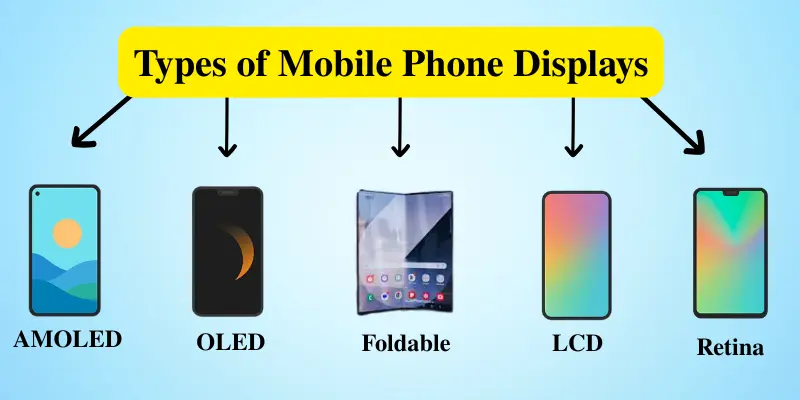
There are various types of mobile displays used in modern smartphones, and each one brings its own set of advantages. Let’s explore the most common and popular mobile display types, so you can understand how they work and which one is best for you.
2.1 TFT LCD (Thin-Film Transistor LCD)
TFT LCD is one of the oldest and most common types of displays found in budget smartphones. It’s a variation of the standard LCD (Liquid Crystal Display) technology, but it uses thin-film transistors to enhance the image quality and provide better control over the liquid crystals.
| Pros: |
|---|
|
| Cons: |
|---|
|
Best For: Budget phones or those who don’t mind sacrificing color accuracy for a lower price.
2.2 IPS LCD (In-Plane Switching LCD)
IPS LCD is an improved version of TFT LCD. It uses in-plane switching technology, which keeps the liquid crystals parallel to the screen, resulting in better color accuracy and wider viewing angles.
| Pros: |
|---|
|
| Cons: |
|---|
|
Best For: Mid-range smartphones where you want vibrant colors and better viewing angles without breaking the bank.
2.3 OLED (Organic Light Emitting Diode)
OLED is a display technology where each pixel emits its own light, unlike LCDs, which require a backlight. This allows OLED screens to offer superior contrast, deeper blacks, and more vibrant colors.
| Pros: |
|---|
|
| Cons: |
|---|
|
Best For: Premium smartphones and users who want top-notch display quality for media consumption.
2.4 AMOLED (Active Matrix Organic Light Emitting Diode)
AMOLED is an advanced form of OLED. It’s called “Active Matrix” because it uses an active matrix of OLED pixels that are controlled individually by thin-film transistors (TFTs). This makes AMOLED displays faster, more responsive, and better suited for larger screens.
| Pros: |
|---|
|
| Cons: |
|---|
|
Best For: Flagship smartphones, gamers, and people who consume a lot of media content.
2.5 Super AMOLED
Super AMOLED is an upgraded version of AMOLED that integrates the touch sensors directly into the display, which reduces thickness and improves screen clarity and brightness. Samsung popularized this display technology through its Galaxy smartphones.
| Pros: |
|---|
|
| Cons: |
|---|
|
Best For: High-end smartphones and users who demand excellent display quality in bright environments.
2.6 LTPO AMOLED (Low-Temperature Polycrystalline Oxide AMOLED)
LTPO AMOLED is a newer technology that offers adaptive refresh rates, making it more power-efficient while providing smooth visuals. This technology is often found in high-end flagship smartphones.
| Pros: |
|---|
|
| Cons: |
|---|
|
Best For: Premium smartphones with a focus on performance and battery life.
2.7 Retina Display
Retina Display is a marketing term used by Apple for its high-resolution screens. These screens have such a high pixel density that, from a normal viewing distance, the human eye cannot see individual pixels. In simple words, the screen looks extremely sharp, smooth, and clear.
| Pros: |
|---|
|
| Cons: |
|---|
|
Best For: Apple users who want high-resolution, crisp screens in iPhones, iPads, and Macs.
2.8 Mini-LED
Mini-LED is a new technology that uses miniature LEDs to create a backlight for the display. It’s seen in some high-end devices like tablets and laptops, but is starting to make its way into mobile phones.
| Pros: |
|---|
|
| Cons: |
|---|
|
Best For: High-end tablets and premium devices, with potential for future smartphones.
2.9 Micro-LED
Micro-LED is similar to OLED but uses inorganic materials instead of organic ones. This makes Micro-LED displays less prone to burn-in and potentially more durable over time.
| Pros: |
|---|
|
| Cons: |
|---|
|
Best For: Future high-end smartphones and devices that demand long-lasting screen quality.
2.10 Foldable Displays
Foldable displays use flexible OLED technology, allowing smartphones to fold into a compact form. These displays offer larger screens that can be folded for portability.
| Pros: |
|---|
|
| Cons: |
|---|
|
Best For: People who like the latest technology and want a big-screen smartphone.
3. How to Choose the Best Display for Your Needs
Now that we’ve explored the different mobile displays, you might be wondering which one is best for you. Here’s some quick advice to help you choose the right display:
1. For Budget Buyers
If you’re looking for an affordable smartphone without breaking the bank, TFT LCD or IPS LCD displays are the way to go.
- TFT LCD: Simple, reliable, and easy on the wallet.
- IPS LCD: Offers better colors and wider viewing angles while still being budget-friendly.
These displays are perfect for everyday tasks like texting, browsing, and social media.
2. For Gamers and Media Enthusiasts
If you enjoy watching videos, streaming, or gaming, consider AMOLED, Super AMOLED, or OLED displays.
- AMOLED & Super AMOLED: Provide rich colors, deep blacks, and faster response times, making your media experience more immersive.
- OLED: Offers superior contrast and vibrant colors for a premium viewing experience.
These displays are ideal for those who want top-notch picture quality and smooth performance.
3. For Future-Proofing and Cutting-Edge Tech
If you want a device that stands out and stays relevant for years, Foldable Displays or mini-LED are excellent options.
- Foldable Displays: Give you a large screen in a compact, portable form factor — perfect for tech lovers and trendsetters.
- Mini-LED: Offers incredible brightness, deep contrast, and improved visuals, making it perfect for high-end devices.
| Tip: |
|---|
Always consider your main usage and priorities — whether it’s daily tasks, gaming, media, or exploring the latest technology. Your choice will directly impact your smartphone experience. |
Conclusion
So guys, in this article, we’ve covered types of mobile displays in detail. From my experience, AMOLED or OLED displays offer the best balance of performance, color, and battery life for most users. If you’re on a budget, IPS LCD is a reliable option. Whatever your choice, make sure it fits your usage style and preferences.
Explore the options, compare models, and choose the display that suits you best!
Frequently Asked Questions (FAQs)
Here are the answers to some common questions about types of mobile display:
Not always. Choose a display that fits your usage, budget, and preferences. Cutting-edge displays like Foldable or Mini–LED are amazing, but simpler displays can be more practical for everyday use.
AMOLED, Super AMOLED, or OLED displays are ideal. They provide deep blacks, vibrant colors, and fast response times for a smooth gaming and video experience.
Retina Display is Apple’s marketing term for high-resolution screens. The pixel density is so high that individual pixels are invisible to the eye. It’s very sharp and clear, but mostly found on Apple devices.
IPS LCD offers better color accuracy and wider viewing angles than TFT. TFT is cheaper and simpler, but colors can shift when viewed from different angles. IPS is great for mid-range smartphones.
It depends on your priorities. AMOLED displays provide vibrant colors, deeper blacks, and better contrast, making them ideal for gaming and media. LCD displays like IPS or TFT are more affordable, reliable, and still good for everyday use, like texting and browsing.
Not exactly, but they are very similar. AMOLED is an advanced form of OLED with faster response and better power efficiency. Both offer rich colors and deep blacks.
Yes, especially for budget devices. TFT LCDs are reliable, affordable, and bright enough for texting, browsing, and social media. However, colors may not be as vibrant as OLED or AMOLED.


- Be Respectful
- Stay Relevant
- Stay Positive
- True Feedback
- Encourage Discussion
- Avoid Spamming
- No Fake News
- Don't Copy-Paste
- No Personal Attacks
- Be Respectful
- Stay Relevant
- Stay Positive
- True Feedback
- Encourage Discussion
- Avoid Spamming
- No Fake News
- Don't Copy-Paste
- No Personal Attacks
