Types of Mobile Phone Batteries Explained: Choose Wisely
Published: 7 Mar 2026
Mobile phone batteries are like the heart of your smartphone. They decide how long your phone lasts, how quickly it charges, and how well it works throughout the day. There are different types of batteries, such as lithium-ion, lithium-polymer, and new solid-state batteries.
With so many options present in the tech market, it can be hard to select the best one. Many people face issues like their battery running out too quickly, charging slowly, or getting weaker over time.
In this blogpost, we’ll discuss the main types of mobile batteries. We’ll compare their pros and cons and explain new battery technologies to choose the best one for your phone.
What Are Mobile Phone Batteries?
A mobile phone battery is what powers your smartphone, making it work. It gives energy to all the parts of your phone, such as making calls, using apps, browsing the internet, and more. The battery stores electrical energy and releases it whenever your phone needs it.
There are two main types of mobile phone batteries: primary and secondary. Primary batteries can’t be recharged and are not used much in modern phones. Secondary batteries, like lithium-ion and lithium-polymer, can be recharged and are found in most smartphones today.
These rechargeable batteries play a big role in how long your phone lasts and how well it works.
Main Types of Mobile Phone Batteries
Smartphones today depend on advanced battery types to provide long-lasting power and efficient energy use. Take a moment to consider which battery type best matches your needs before your next purchase.
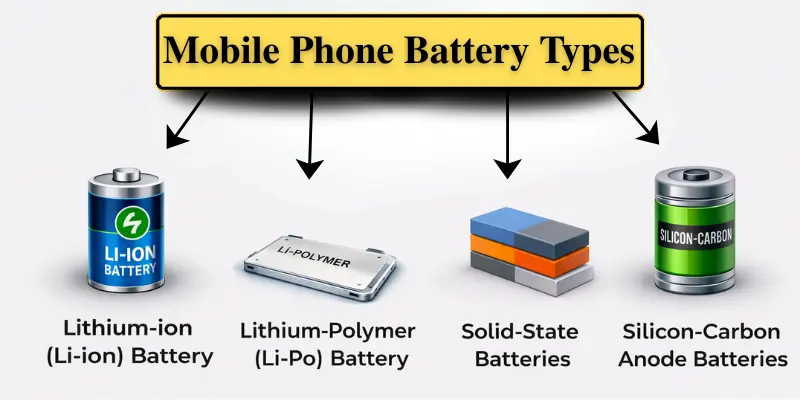
1. Lithium-ion (Li-ion) Battery
Lithium-ion batteries are the most common rechargeable batteries in today’s smartphones. They operate by moving lithium ions between two components called the cathode and anode, during charging and discharging. This movement of ions allows them to store and release energy efficiently.
Key Features:
- High energy density: Holds a lot of power in a small space.
- Rechargeable: Can be recharged hundreds of times before noticeable capacity loss.
- Non-removable: Most smartphones integrate these batteries, making them inaccessible for user removal.
- Typical voltage: About 3.7V.
| Pros: |
|---|
|
| Cons: |
|---|
|
Real-World Examples: Samsung Galaxy S series, Xiaomi Redmi Note series, OnePlus phones.
2. Lithium-Polymer (Li-Po) Battery
Smartphones use newer Lithium-Polymer batteries, a type of rechargeable battery. Unlike Li-ion batteries, Li-Po batteries use a gel-like polymer electrolyte. This design makes them lighter, more flexible, and allows phone manufacturers to create thinner devices.
Key Features:
- Flexible shape: This allows for unique and innovative smartphone designs.
- Rechargeable: Provides a long lifespan with proper care.
- Lower leakage risk: Less likely to leak compared to Li-ion batteries.
| Pros: |
|---|
|
| Cons: |
|---|
|
Real-World Examples: These batteries are found in models such as the Huawei P series, OPPO Find X series, and some Realme and Vivo models.
3. Emerging Battery Technologies
The smartphone industry actively explores new battery technologies to address Li-ion and Li-Po issues. Two promising options are:
1. Solid-State Batteries
Solid-state batteries use solid electrolytes instead of the liquid or gel found in traditional batteries. They deliver several advantages:
- Safer: Less risk of leaks or fires.
- More stable: Works well in different conditions.
- Researchers continue to develop these batteries, and you may see them in high-end smartphones soon.
2. Silicon-Carbon Anode Batteries
This innovative battery technology uses a mix of silicon and carbon for the anode. It has several benefits:
- High capacity: Can hold over ten times more energy than traditional graphite anodes.
- Longer battery life: Lasts longer before needing to be recharged.
- Faster charging: Reduces the time required to recharge.
How to Choose the Best Mobile Phone Battery
Choosing the best mobile phone battery depends on these two important factors: battery type and battery capacity (mAh). Follow these simple steps to choose the right battery for your needs.
1. Compare Battery Types First
Most smartphones use either Lithium-ion (Li-ion) or Lithium-Polymer (Li-Po) batteries. Understanding their differences can help you choose the right option.
| Feature | Li-ion | Li-Po |
|---|---|---|
| Weight | Medium | Light |
| Energy Density | High | Medium |
| Cost | Low | High |
| Durability | Moderate | High |
| Form Factor | Fixed | Flexible |
Best Choice
- Choose Li-ion if you want a reliable and affordable battery.
- Choose Li-Po if you prefer a lighter smartphone with a slim design.
2. Check Battery Capacity (mAh)
Battery capacity tells you how long your phone can last on a single charge. It is measured in milliampere-hours (mAh).
| Capacity | Best For |
|---|---|
| 3000–3500 mAh | Light users (calls, browsing, messaging) |
| 4000–4500 mAh | Moderate users (social media, videos, multitasking) |
| 5000 mAh or more | Heavy users (gaming, streaming, long daily use) |
Best Choice
- If you use your phone occasionally, 3000–3500mAh is enough.
- For balanced daily use, 4000–4500mAh is a good choice.
- For gaming or heavy use, 5000 mAh batteries are the best option.
Popular Smartphone Brands & Battery Types
Here are some smartphone brands that use these battery types and capacities.
| Brand | Model Examples | Battery Type | Capacity (mAh) |
|---|---|---|---|
| Samsung | Galaxy S21, Galaxy A52 | Li-ion | 4000–4500 |
| Xiaomi | Redmi Note 12, Poco X4 | Li-ion | 4500–5000 |
| Huawei | P30, Mate 40 | Li-Po | 4200–4500 |
| OPPO | Find X3, Reno 8 | Li-Po | 4500–5000 |
| Realme | Narzo 50, 9i | Li-Po | 5000 |
| Nokia | G50, 5.4 | Li-ion | 4000 |
Conclusion
We have talked about different kinds of cell phone batteries, such as lithium-ion (Li-ion) and lithium-polymer (Li-Po). We have also talked about newer types, such as solid-state and silicon-carbon anode batteries. If you want your phone to last longer and work better, you need to get the right battery.
Simply choose a battery that works with the way you use your phone. Li-ion is an excellent choice if you want a good and affordable option. If you need something lightweight and safe, Li-Po is a good option.
Keep learning and exploring, buddies! The world of phone batteries is always changing, and knowing more will help you pick the best one for your phone.
Common Questions About Mobile Phone Batteries
Here are the answers to some common questions about types of mobile batteries
Smartphones mostly use rechargeable batteries. The most common types are:
- Lithium-ion (Li-ion): Known for its high energy density, Li-ion batteries are widely used and cost-effective.
- Lithium-Polymer (Li-Po): This type is also rechargeable and is notable for being lightweight, flexible, and suitable for slim devices.
- Emerging technologies: New rechargeable options like Solid-State batteries and Silicon-Carbon Anode batteries provide higher capacity and improved safety.
Both Li-ion and Li-Po batteries have their benefits:
- Li-ion: Affordable, reliable, and long-lasting. It’s commonly found in devices from brands like Samsung, Xiaomi, and OnePlus.
- Li-Po: Lighter, safer, and more flexible, making it ideal for slim designs. It’s used in models from OPPO, Huawei, and Realme.
Tip: Choose Li-Po if you value device design and safety. Opt for Li-ion if you need cost-effectiveness and standard performance. Consider your priorities and make your choice today!
Here are some tips to help extend your mobile battery’s lifespan and performance:
- Avoid draining your phone battery to 0%; charge it when it reaches around 20%.
- Use the recommended charger from the manufacturer.
- Keep your device away from extreme heat or cold.
- Turn on power-saving modes when possible.
- Regularly update your phone’s software, as updates often include improvements that help your battery last longer and work more efficiently.
Most modern smartphones, especially those with Li-ion and Li-Po batteries, have non-removable batteries. While replacement is possible, it’s best to:
- Visit an authorised service centre to avoid damage.
- Use official replacement batteries offered by the brand for safety and longevity.


- Be Respectful
- Stay Relevant
- Stay Positive
- True Feedback
- Encourage Discussion
- Avoid Spamming
- No Fake News
- Don't Copy-Paste
- No Personal Attacks
- Be Respectful
- Stay Relevant
- Stay Positive
- True Feedback
- Encourage Discussion
- Avoid Spamming
- No Fake News
- Don't Copy-Paste
- No Personal Attacks
