History of Mobile Phones: From First Call to Modern Smartphones
Published: 24 Oct 2025
Have you ever thought about how mobile phones evolved from a luxury to a daily necessity? From the first call made on a bulky device to today’s sleek smartphones, the history of mobile phones is very interesting. Whether you’re using a phone to call, text, or check your social media feed, mobile phones have transformed the way we communicate and interact with the world.
In this article, we’ll explain the history of mobile phones, covering everything from their invention to modern-day innovations. So, let’s get started.
The Beginning: The First Mobile Phones
The idea of mobile phones started in the early 1900s when people dreamed of talking without wires. However, the first real mobile phone was made on April 3, 1973, by Martin Cooper, who worked at Motorola. This phone, the Motorola DynaTAC 8000X, was used by Cooper to make the world’s first mobile call. At that time, it was a big invention—this mobile phone weighed 2.5 pounds and needed 10 hours of charging for only 30 minutes of talk time!

| 😊 Fun Fact: |
|---|
The Motorola DynaTAC was so big that people had to carry it in a briefcase! Imagine if your phone today were as heavy and bulky as a brick—how would that feel? |
The 1980s: The Era of the First Commercial Mobile Phones
In the 1980s, mobile phones became available to the public for the first time. With the launch of cellular networks, people could finally use phones without wires. In 1983, Motorola released the first mobile phone you could buy, the DynaTAC 8000X, which cost $3,995 (roughly equivalent to over $12,000 today ).
At that time, phones were big and expensive, and most people who had one were either business owners or wealthy. Mobile phones were considered a luxury item rather than a necessity. Can you imagine paying thousands of dollars for a phone just to show you had one? It’s strange to think there was a time when most people couldn’t own a phone.
The 1990s: The Cellular Revolution and the Rise of Affordable Phones
The 1990s brought a big change to mobile phones. With the introduction of digital networks and the GSM standard, mobile phones started to become smaller, cheaper, and easier for most people to afford. Companies like Nokia and Motorola released popular phones, such as the Nokia 3210 and the Motorola StarTAC, which became household names.
By the late 1990s, phones were no longer just for making calls—they were becoming everyday tools that people used for more than just talking. In 1992, the first text message was sent. From that moment, mobile phones were not just about voice communication; they became essential for staying connected in many different ways.
| 😊 Fun Fact: |
|---|
Do you remember sending your first text message? It may seem easy now, but back then, it felt like a big jump in technology! |
The 2000s: The Rise of the Smartphone
The biggest change in mobile phones came in 2007 when Apple introduced the iPhone. The first model, simply called the iPhone 2G, was priced at $499 for the 4GB version and $599 for the 8GB version. This was the start of the smartphone era as we know it today. The iPhone combined a mobile phone with a touchscreen and an internet browser, and it completely changed how we use our phones. Suddenly, Phones were no longer just for calling and texting; they became small computers with apps, games, cameras, and much more.
The iPhone 2G revolutionized the mobile phone market, and soon, other companies like Samsung, HTC, and Nokia began releasing smartphones with similar features. Phones became sleeker, more powerful, and easier to use. Back then, people didn’t ask what kind of mobile phone you had—they asked what features your mobile phone had.
By 2010, smartphones had officially overtaken feature phones as the most popular choice for mobile communication.
The Modern Era: Mobile Phones Today
Today, in 2025, mobile phones are more advanced than ever before. They are fast, smart, and full of amazing features. Modern smartphones come with powerful cameras, face and fingerprint unlock, large storage, and even AI tools that help you take better photos, translate languages in real-time, or track your health and fitness.
Phones now work almost like mini-computers—you can edit videos, play high-quality games, attend online classes, and do your office work, all from your phone. 5G technology has made internet speed much faster, so streaming and downloading take only seconds.
Some phones even fold, have multiple screens, or support AR (Augmented Reality) and VR (Virtual Reality). So, it isn’t easy to imagine life today without a smartphone!
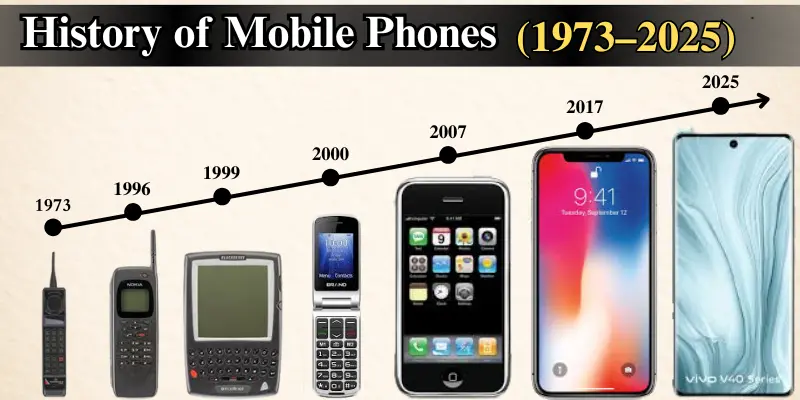
Timeline: Key Milestones in Mobile Phone History (1973–2025)
Let’s take a look at the key milestones that have shaped the evolution of mobile phones over the last 50 years.
1973–1999: The Early Days
- 1973 – The first mobile phone call was made by Martin Cooper, a Motorola executive, using the Motorola DynaTAC 8000X. This was the beginning of mobile phone communication.
- 1983 – The Motorola DynaTAC 8000X became the first commercially available mobile phone, marking a milestone in the history of cell phones.
- 1991 – The launch of 2G networks in Finland improved call quality and enabled basic data transmission, paving the way for future mobile communication technologies.
- 1992 – The first SMS (Short Message Service) text message was sent, reading “Merry Christmas.” This marked the beginning of mobile text communication.
- 1996 – The Nokia 9000 Communicator, a clamshell phone with a full keyboard, blurred the line between a mobile phone and a personal digital assistant (PDA).
- 1999 – The BlackBerry 5810 introduced push email, revolutionizing business communication and setting the stage for mobile email use in daily life.
2000–2010: The Rise of Smartphones
- 2000 – The first camera phone, the Sharp J-SH04, was introduced in Japan, allowing users to capture photos on their phones.
- 2007 – Apple launched the iPhone, revolutionizing the mobile phone industry with its touchscreen interface and the introduction of the App Store, giving rise to the modern smartphone era.
- 2008 – The first Android phone, the HTC Dream (T-Mobile G1), was released, starting the competition between Android and iOS.
- 2009 – Apple’s App Store transformed how users accessed mobile software, making apps an integral part of smartphone experiences.
2011–2020: The Smartphone Boom
- 2011 – 4G networks became widespread, enabling faster internet speeds and the rise of mobile data-heavy services like streaming and video calls.
- 2014 – The first smartwatches, including the Apple Watch, were introduced, integrating mobile phone features like notifications, calls, and health tracking.
- 2017 – Facial recognition became mainstream with the iPhone X, allowing users to unlock their phones using just their face.
- 2019 – 5G networks started rolling out, promising ultra-fast speeds and low latency, opening the way for advancements in mobile gaming, VR, and IoT.
2021–2025: The Future of Mobile Phones
- 2022 – Foldable smartphones became popular, with models from Samsung, Huawei, and Motorola introducing a new form factor with flexible screens.
- 2023 – AI-powered mobile assistants became more advanced, seamlessly integrating into daily life to help users with tasks and automate routine activities.
- 2024 – Satellite connectivity in smartphones allowed users to send messages without cellular networks, improving communication in remote areas.
- 2025 – The rise of quantum communication in mobile devices promised ultra-secure messaging, ensuring the highest level of privacy for users.
Conclusion
The history of mobile phones has come a long way, from the big and costly telephones of the 1980s to the smart and slim phones we use today. Each new change in mobile technology has made life easier and helped us stay more connected. The future looks exciting, and as technology keeps improving, we can only imagine what amazing phones we’ll see next.
Frequently Asked Questions (FAQs)
Here are the answers to some common questions about the history of mobile phones :
The cell phone is over 50 years old, with the first mobile phone ever made introduced in 1973.
Cell phones were invented in 1973, with the first mobile phone ever made being the Motorola DynaTAC 8000X. This device was the starting point of the mobile phone evolution.
Here are the five facts about mobile phones.
- The first mobile phone call was made in 1973.
- The first camera phone was introduced in 2000.
- Smartphones became widely used after 2007.
- The iPhone transformed the phone industry.
- 5G networks started rolling out in 2019, enabling faster speeds.
The first wireless phone was introduced in 1973 with the Motorola DynaTAC 8000X. This was the first device to allow people to make calls without being connected to a landline.
Cell phones were first used in the 1970s, but they were not widely available at that time. The first generation of mobile phones became commercially available in the 1980s, though they were expensive and bulky. It wasn’t until the 1990s that cell phones became more affordable and accessible to the general public, changing the way people communicated daily.



- Be Respectful
- Stay Relevant
- Stay Positive
- True Feedback
- Encourage Discussion
- Avoid Spamming
- No Fake News
- Don't Copy-Paste
- No Personal Attacks
- Be Respectful
- Stay Relevant
- Stay Positive
- True Feedback
- Encourage Discussion
- Avoid Spamming
- No Fake News
- Don't Copy-Paste
- No Personal Attacks
