Power Bank Pros and Cons: Everything You Need to Know
Published: 1 Apr 2026
Your phone battery always seems to die at the wrong time. A power bank solves that problem by providing portable backup power for your phone, tablet, or other USB devices when no socket is nearby. It helps during travel, long commutes, outdoor trips, and power cuts.
However, before buying one, it is important to understand its advantages and disadvantages. While they offer convenience and fast charging, they also have some limitations.
In this guide, you will learn the real pros and cons of power banks in a simple and practical way, helping you decide whether it is the right choice for your daily needs.
What is a Power Bank? (Quick Overview)
A power bank is a portable device that stores energy to charge your electronics on the go, such as smartphones, tablets, and laptops. It uses lithium-ion or lithium-polymer batteries and transfers stored energy via USB connections.
How It Works
- Store energy: You charge the power bank through a wall socket or USB port.
- Transfer energy: When you connect your device, the power bank supplies energy to charge it.
Key Advantages of Power Banks
From travel to everyday use, here are the key reasons why power banks are essential for your daily tech needs.
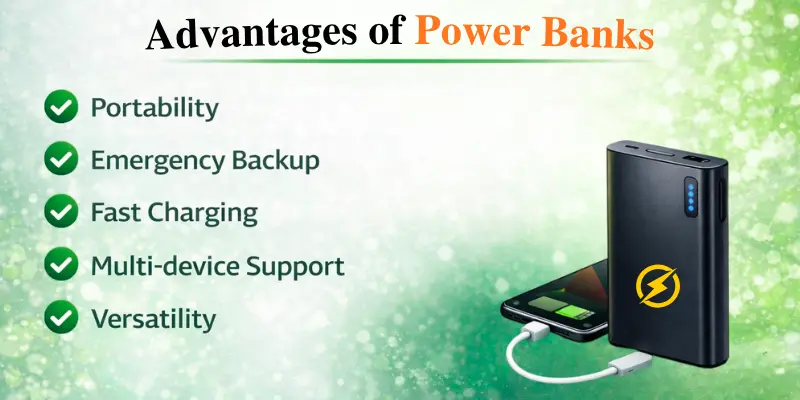
- Portability
- Emergency Backup
- Fast Charging
- Multi-device Support
- Versatility
Let’s start to discuss the benefits of power banks in detail.
Portability
One of the main advantages of a power bank is portability. These devices are made to be compact and easy to carry, so you can keep one in your pocket, backpack, or handbag. Whether you’re traveling, commuting, or spending time outdoors, a power bank lets you charge your devices without hunting for a wall socket.
Some common situations where portability helps:
- Traveling on flights or long road trips
- Daily commuting to work or university
- Outdoor activities like hiking or camping
Emergency Backup
A power bank gives you backup power when you need it most. If the electricity goes out or you’re stuck somewhere without access to charging, it helps keep your important devices running. That can matter a lot when you need to make a call, check maps, or stay in touch during an emergency.
Where emergency backup becomes useful:
- Power cuts at home
- Natural disasters or emergency situations
- Remote areas with limited electricity
Fast Charging
Many modern power banks support fast-charging features like Power Delivery (PD) and Quick Charge (QC), which help charge devices more quickly. That means you can give your phone a quick boost when you’re in a rush instead of waiting around for a slow charge.
Why fast charging matters:
- Quick top-ups before meetings or travel
- Saves time for busy users
- Better for devices that need more power
Multi-Device Support
Another strong benefit is the ability to charge more than one device at the same time. Many power banks come with multiple ports, so you can connect your smartphone, earbuds, smartwatch, or tablet together.
This is especially helpful when:
- You carry multiple gadgets every day.
- You’re traveling with friends or family.
- You want to avoid carrying several chargers.
Versatility
Power banks are useful with many different USB-powered devices. From smartphones and tablets to Bluetooth speakers and cameras, a single power bank can meet multiple charging needs. That makes it handy for both daily use and unexpected moments.
How versatility adds value:
- Works with different kinds of devices
- Useful for work and entertainment
- Fits many situations and user needs
Quick Overview of Power Bank Advantages:
| Advantage | Explanation | Real-Life Example |
|---|---|---|
| Portability | Charge on the go | Travel, commuting |
| Emergency Backup | Useful during power cuts | Blackouts, outages |
| Fast Charging | Saves time | Quick top-ups |
| Multi-device Support | Charge more than one gadget | Phone + earbuds |
| Versatility | Works with many devices | Cameras, speakers |
Disadvantages of Power Banks
Power banks have drawbacks that can affect performance, including charging inefficiency and safety concerns. Here are the 5 cons of the power bank.
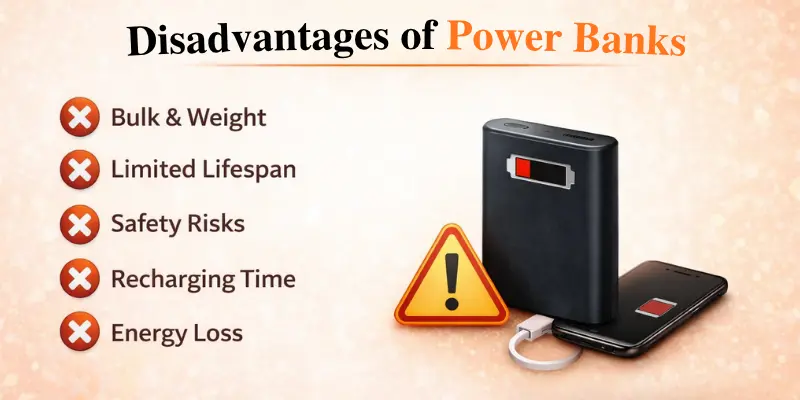
- Bulk & Weight
- Limited Lifespan
- Safety Risks
- Recharging Time
- Energy Loss
Let’s start to discuss the disadvantages of power banks in detail.
Bulk & Weight
Power banks are portable, but larger-capacity models such as 10000 mAh or 20000 mAh can feel heavy and bulky. That makes them harder to carry in your pocket, especially if you want something light for daily use.
Common drawbacks of bulkier power banks:
- Hard to fit in small pockets
- Adds extra weight to your bag
- Not the best choice for light travel
Limited Lifespan
Power banks use lithium-ion or lithium-polymer batteries, which do not last forever. They start to lose strength after repeated charging and recharging, and hold less power than before.
What this means for users:
- Lower charging capacity over time
- Slower or weaker performance after months or years
- Replacement becomes necessary at some point.
Safety Risks
Not every power bank is made to the same standard. Cheap or fake products can overheat, swell, or become dangerous if used improperly or made with poor materials.
Potential risks include:
- Overheating while charging
- Short circuits or battery damage
- Fire risk in serious cases
Recharging Time
A power bank must be charged before it can charge your other devices. Based on its size and charging speed, it can take several hours which can be frustrating if you need it again quickly.
Why is this a limitation?
- Not ready again right after it runs out
- Larger models can take 6 to 15 hours.
- You need to plan ahead.
Energy Loss (Inefficiency)
Power banks do not pass every bit of stored power to your device. Some energy is lost as heat during charging, so the actual output is usually lower than the number printed on the box.
Impact on performance:
- Fewer charges than expected
- Lower overall efficiency
- Some power is lost during transfer.
Quick Overview of Power Bank Disadvantages:
| Disadvantage | Explanation | Impact |
|---|---|---|
| Bulk & Weight | Higher mAh often means more weight | Less pocket-friendly |
| Limited Lifespan | Battery quality drops over time | Needs replacement |
| Safety Risks | Cheap models can overheat | Fire risk |
| Recharging Time | Takes hours to refill | Not ready right away |
| Energy Loss | Power transfer is not fully efficient | Less actual output |
When a Power Bank Is Actually Useful
Knowing where a power bank helps in real life makes its value easier to understand. It’s not just about specs on a box. In many daily situations, a power bank can save you from stress, delay, or being stuck with a dead phone.
- Travel & Flights: When you travel, especially on long flights or road trips, it can be tough to find places to charge your devices. A power bank keeps your devices working the whole trip without needing to find a wall outlet.
- Students & Daily Commute: Students and working professionals often spend many hours away from home. Between classes, office work, and commuting, battery drain becomes a common problem.
- Outdoor Activities (Hiking & Camping): When you are outdoors, you usually cannot find electricity. A power bank can help you stay comfortable and safe with its energy backup ability.
- Emergencies & Power Cuts: During sudden power cuts, a power bank can be a real lifesaver. It helps keep your main devices working when you need them most.
- Heavy Phone Users (Gaming & Content Creators): If you use your phone a lot for gaming, streaming, or making content, the battery can run down fast. A power bank helps you keep going without constant breaks.
Situations Where Power Banks Are Not Ideal
Power banks are useful, but they are not the right choice in every situation. In some cases, using it can lower performance or create safety problems.
- During Overheating: If your power bank or phone becomes too hot, stop using it right away. Heat can damage the battery and raise safety risks.
- Using Damaged Cables: Do not use broken or poor-quality cables. They can cause slow charging, short circuits, or damage to your device.
- Overnight Charging (Low-Quality Banks): Avoid overnight charging with cheap power banks. Low-quality models may overheat or create charging problems during long use.
- Extreme Temperatures: Do not use power banks in very hot or very cold places. Extreme temperatures can reduce battery performance and harm the battery over time.
Which Power Bank Capacity Is Best?
The best power bank capacity depends on how often you use your devices and where you plan to use them. Capacity is measured in mAh (milliampere-hour), which shows how much charge a power bank can store.
| Capacity | Best For | Charging Cycles |
|---|---|---|
| 5000mAh | Light users | ~1 charge |
| 10000mAh | Daily use | 2-3 charges |
| 20000mAh | Travel and heavy use | 4-6 charges |
Conclusion
So guys, in this article, we’ve covered the advantages and disadvantages of power banks in detail. Power banks are a reliable solution for staying connected, especially during travel, busy days, or emergencies. However, choosing the right capacity and a trusted brand is very important to avoid common issues.
I personally recommend going for at least a 10000mAh power bank with safety features for everyday use.
If you found this article helpful, don’t forget to share it with your friends so they can benefit too!
Frequently Asked Questions (FAQs)
Here are some common questions people ask about the pros and cons of power banks :
Before buying a power bank, check its capacity, safety, charging speed, and ports. These things decide how useful, safe, and suitable it will be for your phone and daily use.
No, a power bank does not damage your phone battery if it is made of good quality and used properly. Battery problems usually happen because of cheap power banks, damaged cables, overheating, or poor charging habits. Use a trusted power bank and avoid low-quality accessories.
Power banks are not completely eco-friendly because they use batteries that can harm the environment if thrown away carelessly. Recycling old power banks properly can reduce their environmental impact. Choosing power banks from brands that follow green manufacturing helps make them a bit safer for the planet.
A 10000mAh power bank is best for daily carry. A 20000mAh model suits travel or multiple devices. Choose based on your needs. Pick 10000mAh for light needs and 20000mAh for heavy use.
A power bank usually lasts 2 to 5 years, depending on its quality, usage, and care. Over time, it stores less charge and becomes less effective. Good brands usually last longer than cheap ones.
Yes, you can usually take a power bank on a plane, but it must stay in your carry-on bag, not checked luggage. Airline rules may differ based on battery size. Check your airline’s rules before flying.






- Be Respectful
- Stay Relevant
- Stay Positive
- True Feedback
- Encourage Discussion
- Avoid Spamming
- No Fake News
- Don't Copy-Paste
- No Personal Attacks
- Be Respectful
- Stay Relevant
- Stay Positive
- True Feedback
- Encourage Discussion
- Avoid Spamming
- No Fake News
- Don't Copy-Paste
- No Personal Attacks
