POLED vs AMOLED: Full Comparison Guide for Buyers
Published: 4 Mar 2026
POLED and AMOLED are both advanced OLED display technologies used in modern smartphones. The main difference between these two is simple: POLED uses a plastic layer, making it more flexible, while AMOLED uses an active-matrix system that controls each pixel individually.
Both offer vibrant colours, deep blacks, and quick response times, but they differ in flexibility, durability, and how they are used in different devices.
If you’re unsure which display technology is better for gaming, eye comfort, durability, or long-term use, then this blog post will explain everything you need to know.
What Is AMOLED?
AMOLED stands for Active-Matrix Organic Light Emitting Diode.
The “Active Matrix” part explains how the pixels are controlled. Instead of just powering rows and columns like older screens, AMOLED displays use tiny switches to control each pixel individually.
Key Features of AMOLED:
- Faster refresh rates: 90Hz, 120Hz, 144Hz
- Excellent brightness levels: Great for outdoor use
- Strong color accuracy: Vibrant and sharp colours
- Deep blacks & infinite contrast: Perfect for watching movies or playing games
- Common in Samsung flagship phones: A popular choice for premium devices
Important Clarification
Some people believe that AMOLED is a completely different technology from OLED. But that’s not true! AMOLED is a method for controlling the pixels in OLED displays. Most modern OLED screens are active-matrix by default.
What Is POLED?
POLED stands for Plastic Organic Light Emitting Diode.
The “Plastic” part explains the main difference. Instead of using a traditional glass base like many older OLED screens, POLED uses a flexible plastic substrate. This plastic layer makes the display lighter, thinner, and bendable. Because of this plastic base, POLED screens can curve, fold, and even roll in advanced devices.
Unlike AMOLED, which explains how pixels are controlled, POLED focuses on the material used underneath the display.
Key Features of POLED:
- Flexible and movable: Can be curved or folded easily.
- Lightweight: Makes devices lighter.
- Increased shock resistance: Better for devices that need to withstand drops.
- Used in curved and foldable phones: Ideal for phones with unique shapes.
- Commonly manufactured by LG: LG is a major producer of POLED screens.
Important Clarification
POLED refers to the material used for the base layer, not how the pixels are controlled. So technically:
- AMOLED = pixel control system
- POLED = substrate material
Both are types of OLED technology, but they describe different parts of how the display is built.
Key Differences Between AMOLED and POLED Displays
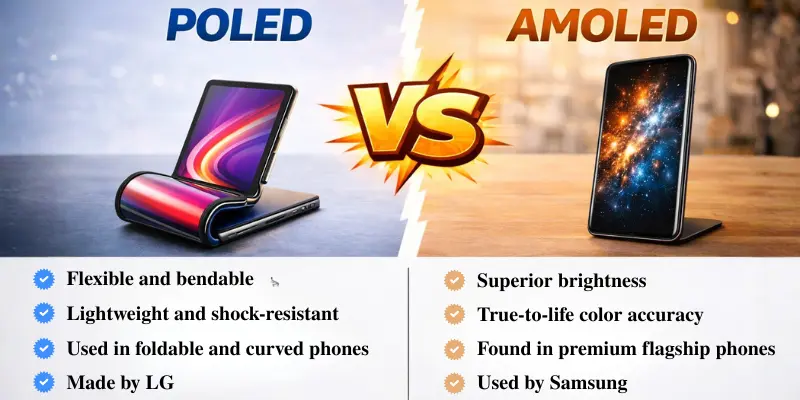
POLED and AMOLED both use OLED technology, but they are made with different materials, built in different ways, have different levels of flexibility, and serve different purposes. Here’s a breakdown of their main differences.
1. Full Form
- POLED: Stands for Plastic Organic Light Emitting Diode. It uses a plastic substrate.
- AMOLED: Stands for Active Matrix Organic Light Emitting Diode. It refers to the system used to control individual pixels.
2. Core Difference
- POLED: Focuses on the flexible plastic base beneath the screen.
- AMOLED: Refers to the method of controlling pixels using an active-matrix system.
3. Flexibility
- POLED: Highly flexible because of the plastic base, allowing it to bend and curve.
- AMOLED: Usually less flexible when made on glass, but this can change based on the design.
4. Durability
- POLED: More shock-resistant since plastic absorbs impacts better than glass.
- AMOLED: Strong and premium in build, but may be a bit more rigid compared to POLED.
5. Brightness
- POLED: Offers great brightness for regular use.
- AMOLED: Often achieves higher peak brightness, making it better for outdoor visibility, especially in premium phones.
6. Color Accuracy
- POLED: Provides vibrant colours and deep blacks like other OLED displays, but color accuracy can vary depending on screen calibration.
- AMOLED: Known for more precise color tuning, especially in high-end smartphones, offering more accurate and natural-looking colours.
7. Gaming Performance
- POLED: Supports smooth gaming with fast response times.
- AMOLED: Optimized for superior gaming performance with higher refresh rates and better motion clarity.
8. Used By
- POLED: Commonly used by brands like LG and Motorola.
- AMOLED: Widely used by Samsung and many other premium smartphone brands.
9. Best For
- POLED: Perfect for foldable devices and curved-screen smartphones due to its flexibility.
- AMOLED: Preferred in premium flagship phones for top-tier brightness, HDR quality, and display performance.
10. Quick Comparison Table
| Feature | POLED | AMOLED |
|---|---|---|
| Substrate | Plastic | Glass (Traditionally) |
| Flexibility | High | Moderate |
| Durability | Shock-resistant | Rigid but premium |
| Brightness | Very Good | Excellent |
| Color Accuracy | Very Good | Excellent |
| Gaming | Smooth | Excellent |
| Best For | Foldables | Flagships |
Performance-Based Comparison
Now, let’s compare their performance side by side.
Which Display Has Better Picture Quality?
OLED technology allows both POLED and AMOLED screens to produce high-quality images. But how do they perform in real-world applications?
1. Color Accuracy
- AMOLED: Known for showing colors very accurately and handling HDR really well, especially in high-end devices.
- POLED: Shows bright colors and deep blacks, but how accurate the colors look can change depending on how the device is set up.
2. HDR Performance
- AMOLED: Shows HDR (High Dynamic Range) content better, especially in top devices where the processing is improved.
- POLED: Also works with HDR content, giving better contrast and color depth, but it might not work as well as AMOLED in top devices.
POLED vs AMOLED for Gaming: Which Display Is Better?
Both POLED and AMOLED displays are great for gaming because of their fast-response OLED technology. Let’s look at how each one performs during gaming.
1. Response Time
- POLED: Has fast pixel changes for smooth movement in fast games.
- AMOLED: Also reacts very quickly, which helps prevent blurry movement in action games.
2. Refresh Rate
Both POLED and AMOLED displays support high refresh rates such as 90Hz, 120Hz, and sometimes even 144Hz. In premium smartphones, AMOLED panels are often better optimized for maintaining higher refresh rates consistently, which can result in smoother animations and scrolling.
3. Touch Sampling Rate
Both screens react quickly to touch. However, AMOLED screens on top smartphones may respond even faster, helping reduce lag for serious gaming.
4. Motion Clarity
Both POLED and AMOLED displays offer clear and smooth motion because OLEDpixels can change instantly. In high-end smartphones, AMOLED panels may deliver slightly smoother movement due to better software optimization and display tuning.
Which Is Better for the Eyes?
Both POLED and AMOLED use OLED technology, so their eye comfort is quite similar. The difference usually depends on screen tuning and phone optimization.
1. Blue Light
Both displays emit blue light, which can cause eye strain. Most modern phones include blue light filters or eye comfort modes to reduce this effect.
2. PWM Dimming and Flicker
PWM (Pulse Width Modulation) controls brightness at low levels. Both POLED and AMOLED may use it, and at very low brightness, it can cause slight flicker, which may bother sensitive users. In high-end phones, AMOLED panels often use higher PWM frequencies to reduce visible flicker and improve eye comfort.
3. Dark Mode
Both POLED and AMOLED benefit from dark mode. When dark content is displayed, OLED pixels turn off completely to produce true blacks. This reduces overall brightness, lowers eye strain in low light, and can also help save battery life.
Which One Should You Choose?
Let’s simplify your decision to choose between POLED vs AMOLED:
Choose POLED If:
- You want a foldable phone.
- You prefer curved displays.
- You need shock resistance.
Choose AMOLED If:
- You want flagship-level brightness.
- You prioritise colour accuracy.
- You want the best quality for watching videos with bright and dark scenes.
For Most Users:
You won’t notice a dramatic difference in daily use. Focus on:
- Overall phone quality
- Display calibration
- Brand optimization
Common Myths about POLED and AMOLED
There are many myths about POLED and AMOLED that can confuse people. Let’s clear up these misunderstandings to help readers make accurate decisions!
Myth 1: “AMOLED is Always Better”
The Truth: Many people think AMOLED is always better than POLED, but both use OLED technology and have similar picture quality.
The real difference comes from how the screen is made, how bright it gets, and how the device is set up.
Myth 2: “POLED Is Cheaper Quality”
The Truth: POLED uses a plastic base that is both flexible and strong, which does not mean it is lower quality.
In fact, POLED works well for foldable and curved devices and can be just as tough, or even tougher, than AMOLED in everyday use.
Myth 3: “They Are Completely Different Technologies”
The Truth: POLED and AMOLED are not totally different technologies. Both are types of OLED screens.
The main difference is that AMOLED is about how the pixels are controlled, while POLED is about using a plastic base.
Conclusion
So guys, both POLED (Plastic Organic Light Emitting Diode) and AMOLED (Active Matrix Organic Light Emitting Diode) have great screens with bright colors, deep blacks, and smooth images.
The main difference is how they are made: POLED can bend, so it works well for foldable and curved phones, while AMOLED is better for bright screens, true-to-life colors, and excellent picture quality, especially in high-end phones.
For most people, the difference in daily use isn’t huge. The best choice depends on your phone and what you care about most.
Whether you want a cool design or top-quality pictures, both types deliver an awesome display when used correctly.
Frequently Asked Questions (FAQs)
Here are the answers to some common questions about the differences between AMOLED and POLED displays.
No, POLED is not always better than AMOLED. POLED works well for foldable and curved devices because it is flexible, while AMOLED has brighter screens, more accurate colors, and better picture quality, which makes it good for high-end phones.
AMOLED is generally more expensive than POLED. AMOLED displays often cost more due to their advanced features, such as higher brightness and better color precision.
Yes, POLED is good for gaming. It offers fast response times, ensuring smooth gameplay. However, AMOLED may have a slight advantage in high-end devices due to higher refresh rates and superior motion clarity, which refers to the ability to display fast-moving images more clearly.
AMOLED might last slightly longer than POLED. Both displays are long-lasting, and AMOLED is often more reliable due to advanced manufacturing processes, particularly in high-end smartphones.
POLED and AMOLED are both eye-friendly. Both displays can be adjusted with blue light filters and dark mode. Comfort depends more on device settings than on display type.





- Be Respectful
- Stay Relevant
- Stay Positive
- True Feedback
- Encourage Discussion
- Avoid Spamming
- No Fake News
- Don't Copy-Paste
- No Personal Attacks
- Be Respectful
- Stay Relevant
- Stay Positive
- True Feedback
- Encourage Discussion
- Avoid Spamming
- No Fake News
- Don't Copy-Paste
- No Personal Attacks
